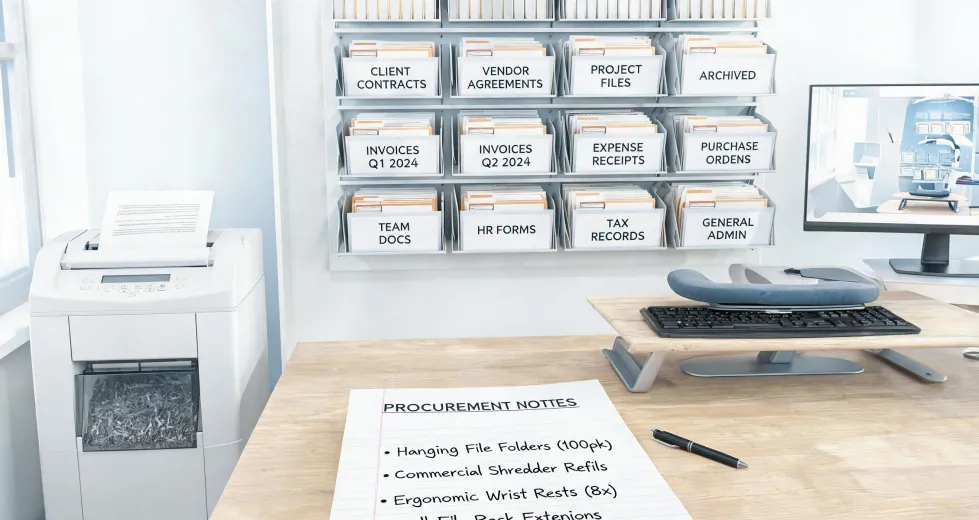
For the last five years, I've been the office administrator at a 60-person logistics company. I manage all office supply and equipment ordering — roughly $40,000 a year across eight vendors — and I report to both operations and finance. The job puts a lot of random questions on my desk: decimal calculators, printers, shredders, and the occasional request for a 3D printer.
If I've learned one thing, it's this: equipment buying has no universal answer. It has scenarios. Sort your situation into the right one, and the buying decision becomes a lot clearer.
Most requests I see fall into three groups: security-critical equipment, daily workhorses, and shiny new technology that no one has actually planned for. Here's how I think through each one.
Scenario One: When the Shredder Is a Security Tool
I used to treat shredders like any other supply order. Compare prices, pick the cheapest reasonable option, move on. That changed in 2021. I ordered a Fellowes Powershred unit from a marketplace seller that looked authorized but was not. I assumed a warranty was a warranty. I did not verify. When the cutter jammed three months later, the seller stopped responding, and the manufacturer could not help because the unit came through an unauthorized channel. We bought a second shredder out of the department budget. Not ideal.
So when someone asks me where to buy Fellowes paper shredders, my answer is simple: start with authorized dealers. That means the Fellowes website, a major office supply chain, or a dealer whose authorization you can verify before you pay. I've seen price differences of 10-20% between authorized dealers and random marketplace listings (based on quotes I gathered in January 2025; verify current pricing). But that difference buys certainty: a real warranty, a person to call, and a manufacturer who will honor the claim when something goes wrong.
Before you buy, check the security rating too. General office paperwork does fine with a cross-cut shredder. If you're shredding client records or legal documents, look for a micro-cut model with a security level like DIN 66399 P-4 or higher. When in doubt, ask your compliance team. They always have an opinion.
A lot of shredder problems happen after the purchase, which brings me to Fellowes paper shredder parts. My advice: buy genuine parts. A replacement gear, cutter assembly, or sensor from Fellowes is built to the exact specifications of your model. A generic part might fit. It also might not. And 'might' is not a risk I want when the equipment handles sensitive information.
But before you order any parts, rule out the simple stuff. A shredder that jams constantly is often just dry. Fellowes sells shredder oil, and the maintenance instructions in the manual are easy to follow — for most models, you apply a little oil across the cutter after emptying the bin. I cannot tell you how many 'broken' shredders were revived by that $7 bottle of oil. Embarrassingly, I learned this after ordering a new cutter assembly that was backordered. Guess what fixed the machine while I waited?
For repair versus replace, I use a simple rule. If the shredder is less than four years old and the problem is one component, repair it. If the cutter is dull after years of heavy use, compare the part price to the price of a new shredder. When the replacement part costs more than half the price of a new machine, buy the new machine. The fresh warranty is worth more than a rebuilt cutter.
Scenario Two: Printers and Calculators Are Workhorses
Not every purchase should keep you up at night. Some equipment only needs to work. Printers and calculators are the clearest examples I know.
We use Brother printers in our satellite offices. I am not here to tell you Brother is the only brand that matters; I have not tested every printer on the market, and you shouldn't trust anyone who claims they have. But the Brother printers we've run have been dependable for everyday black-and-white work. Toner is easy to find, and when I look for a Brother printer manual or support page, the information is where it should be.
The real cost of a printer isn't the sticker price; it's the cost per page plus the hours your team loses to paper jams and error messages. A $150 printer that jams weekly is more expensive than a $300 printer that runs all quarter without a problem. That's a lesson we learned with a budget model that spent more time with an error light on than actually printing. It was not a fun quarter.
Calculators are even simpler. When our accounting team asks for a decimal calculator, the whole decision takes five minutes. For occasional use, a basic ten-key model with a clear display is plenty. If someone is entering numbers all day, the better keypad and faster response of a slightly more expensive model are worth it. What is not worth it is extra functionality no one will use. Our finance team does not need a calculator that prints receipts or stores equations. Every unused button is just desk clutter.
Scenario Three: When Someone Asks for a 3D Printer
The third bucket is where good purchasing discipline goes to die. Someone reads about a technology, gets excited, and asks for one. Lately, the request in our office has been for a 3D printer.
When our engineering lead first asked, I did not know. If you've been searching 'how does a 3d printer work step by step,' here's the version I wish I'd found before I fell down an internet rabbit hole.
- Start with a 3D model. The file, usually an STL, is loaded into slicing software.
- Slice the model. The software cuts the object into dozens or hundreds of thin horizontal layers and calculates the path for each one.
- Melt the filament. The printer feeds plastic filament into a heated nozzle, melting it to the right temperature.
- Print the first layer. The nozzle moves across the build plate, laying down melted plastic in the exact shape of the first layer.
- Keep building. The nozzle or build plate shifts up slightly, and the printer lays the next layer on top. That repeats until the object is complete.
The core process sounds simple, and it is. The hard part is making it reliable. Bed leveling, layer height, print speed, and material quality all affect the result. A 3D printer is not a set-and-forget office machine. It is a tool that wants attention.
So when is one worth buying? If your team designs physical parts and needs prototypes regularly — and someone actually wants to operate and maintain the machine — a 3D printer can pay for itself. If the request is just general curiosity, it is usually a mistake. The machine, the filament, the failed prints, and the troubleshooting hours add up fast.
For one-off jobs, a professional print service is cheaper and more predictable. When we needed a trade show prototype on a deadline in 2024, a print service guaranteed the delivery date. I paid more than I would have for an in-house machine, but the certainty was the point. Missing that deadline would have cost far more than the service fee. That is the same logic I use for shredders and printers: when being wrong is expensive, pay for certainty.
How to Tell Which Scenario You're In
If you are not sure which bucket a request falls into, ask three questions:
- Would failure create a security, compliance, or deadline problem? That's Scenario One. Buy from an authorized source and do not gamble on price.
- Will people use this daily and expect it to just work? That's Scenario Two. Pick a dependable option and stop second-guessing.
- Is this a new technology with no clear owner, no training plan, and no specific job to do? That's Scenario Three. Press pause.
The biggest lesson from 70+ orders a year is this: don't sort by sticker price. Sort by the cost of being wrong. If being wrong means a data incident or a missed deadline, the premium for certainty is not an expense. It's an insurance policy. If being wrong costs $15 on a calculator, don't spend three hours researching it. Just buy one and move on.
One caveat: this is based on what has worked in our office as of early 2025. Prices, dealers, and product lines change. If you're buying one shredder for a home office instead of equipping a 60-person company, your situation is different. Use the framework, not my exact numbers.
Office equipment buying is not glamorous. But when you know which scenario you're in, it stops feeling like a guess. In this job, that's the best outcome I can ask for.

Leave a practical note