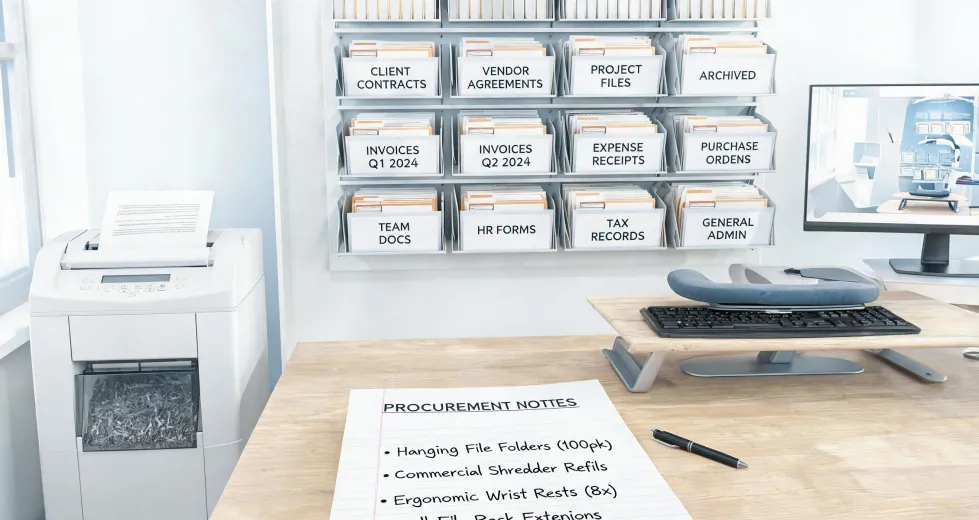
The Shredder Stopped at the Worst Time
Last spring, I found myself standing next to a Fellowes Powershred 99Ci that had decided to die exactly two weeks before our annual file destruction deadline. At a 70-person law firm, that counts as an emergency. We had cabinets of old client files that needed to be shredded before the compliance review, and the shredder was the only one big enough to handle the volume.
Replacing the whole unit would have cost around $2,100 and taken three weeks. A local repair shop quoted almost $1,000. Neither fit the budget or the calendar. Then I remembered that Fellowes sells replacement parts directly. That was the start of a lesson I keep relearning: the cheapest solution is only cheap until it costs you time.
The Compatible Replacement Part That Wasn't
A quick search for fellowes paper shredder replacement parts returned all the usual options. I skipped past the official listing and picked a third-party part for $139. The description said it fit the 99Ci. The photo looked identical. I ordered it with next-day delivery and felt good about saving $125.
It didn't fit.
Actually, the main mounting holes lined up, but the cutter alignment was off by a couple of millimeters. The machine made a grinding noise, then the safety mechanism kicked in. I spent an afternoon figuring out why, and then another day arranging the return. The part cost $139, the return shipping was $18, and the delay changed a two-week deadline into a nine-day one.
The genuine Fellowes replacement part was $286, plus $45 for overnight shipping. I called support, confirmed the part number, and ordered it at 2 p.m. It arrived before 9 the next morning. It took our facilities person about twenty minutes to install. Total cost: $331. Total cost of the experimental route, including labor and frustration: higher.
Ergonomic Chairs Weren't an Extra, They Were Part of the Plan
While I was waiting for the right part, HR asked if I could rush four ergonomic office chairs. The records clerks were about to spend long days sorting and shredding, and the old chairs were the kind that made you feel every hour.
I compared a $170 chair from a discount office supply site with a Fellowes Office Suites chair with mesh back support. Two things bothered me about the discount option: the lead time was two weeks, and the reviews mentioned issues with the gas lift after six months. The Fellowes chair cost $289, was in stock at a local distributor, and would arrive in three days. The extra $119 per chair covered delivery before the project ended and a real warranty.
It wasn't a flashy purchase, but by the end of the project nobody mentioned back pain during those long audit prep days. That's the kind of quiet result I like.
How to Get a Printer Online With a Date I Could Trust
The third fire involved 1,200 notices that had to be printed, folded, and mailed by Friday. Our office printer could handle it, but if it went down while we were running the job, we'd be stuck. I needed a backup provider, and I needed it fast.
This meant finding a reliable online print shop. The phrase I kept typing was how to get a printer online, but what I really wanted was how to get a guarantee along with it. A local shop quoted $460 and said they'd probably have it Thursday. An online printer quoted $190 for standard five-day production, but no guaranteed arrival date. For $95 more, they offered rush production with guaranteed two-day delivery. Total: $285.
My first instinct was to take the $190 standard option. The deadline was Friday, so five business days would maybe land on Thursday? But maybe was exactly the problem. If the file had a typo or their queue slipped, I'd have no buffer. The extra $95 bought certainty, not just speed.
I paid for rush. The package arrived Thursday morning, giving us time to check it and send it to the mailroom. That's what the money bought: a Thursday I could use instead of a Friday I had to worry about.
What the Rush Charges Actually Bought
After six years of tracking about $180,000 in cumulative office spending, I've stopped treating rush fees as pure waste. They're insurance. When a delay means missing a compliance deadline or installing the wrong part on a critical machine, the cheap route isn't a bargain. It's a gamble.
I'm not an equipment engineer, so I can't explain cutter tolerances or chair ergonomics. What I can tell you, from a procurement perspective, is that every choice came down to two questions: What does this really cost? And what happens if it's late?
Procurement math is not that different from a child support calculator: if you leave out an input, the result won't hold up when someone checks it. Leave out the return shipping, the overnight fee, or the chance of a missed deadline, and the answer looks better than it is. The real result only appears when all the inputs are honest.
Now I compare vendors with a simple rule: if the delivery date is fixed, a slightly higher price is not an expense. It's the premium that makes everything else possible.

Leave a practical note