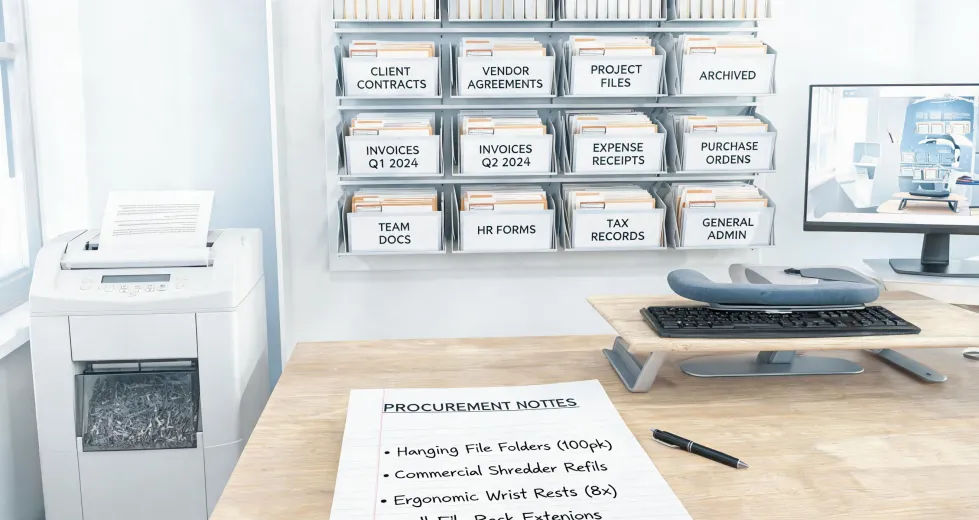
I'm a procurement coordinator handling education supply orders for two districts. Six years in, I've personally made — and documented — 23 significant mistakes, totaling roughly $4,700 in wasted budget. Now I maintain our team's checklist so nobody repeats them.
Here's what I've learned the hard way: there's no universal advice for this stuff. The right move depends entirely on which scenario you're in. So instead of a single "best practice," I'm breaking this into three situations I've actually fumbled.
- Scenario A: You're placing an order with Nasco Education and wondering whether discount codes are worth the effort.
- Scenario B: You're picking digital calculation tools for a classroom — I've had teachers request both a simplify calculator and a starbucks calorie calculator in the same semester.
- Scenario C: You're trying to change a default printer and have already clicked through three wrong settings menus.
They don't share a single solution. But they do share a pattern: five minutes of checking beats five days of fixing. Here's what I've got.
Scenario A: The Nasco Education Order
Quick background: Nasco Education is a Wisconsin-based company founded in 1941, focused on hands-on learning materials for schools — science lab supplies, art materials, classroom equipment. They're not a discount retailer, so the assumption that a Nasco education discount code is always floating around needs some reality-checking.
That assumption cost me $287.
In September 2022, I was placing an $890 order for science lab materials — specialized cultures, dissection kits, that kind of thing. I found a discount code on a third-party coupon site promising 15% off. Applied it at checkout. The system accepted it. Confirmation page said "discount applied."
Spoiler: it wasn't. The fine print excluded "specialized science materials" — which was about 70% of my order. The discount only applied to general supplies. My actual savings: $12. But because I spent two extra days verifying the discount with customer service, our order missed the standard shipping window. Rush shipping on the science cultures alone added $287.
So here's my scenario-based advice for Nasco orders:
If you're buying standard classroom supplies
Art paper, markers, basic office items — a Nasco education discount code from their own promotional page is probably worth checking. General merchandise tends to qualify. To be fair, their official promo page is usually accurate; it's the third-party coupon sites that leave out exclusions.
If you're buying specialized science lab materials
Don't count on discount codes. High-margin, low-frequency items like lab cultures tend to sit outside promo coverage. That's not a knock on Nasco — it's how most education suppliers structure their promotions. Compare the full price against alternatives rather than spending three days hunting for a code that won't apply.
If you're up against a deadline
Skip the coupon hunting entirely. I'm serious. Based on the fee structures I've tracked across online vendors in 2025, rush premiums for next-business-day service run roughly 50–100% over standard pricing. Supplier shipping tiers follow similar patterns. Saving 15% on a $300 order and then paying $250 in rush fees is a losing trade.
The counterintuitive part: sometimes the cheapest move is not using a discount. That sounds backwards until you account for delay costs and the time spent verifying coverage. I still kick myself for that $287. If I'd read the exclusion list before applying the code, I'd have placed the order on time and saved more than the so-called discount ever offered.
Scenario B: Picking Classroom Calculation Tools
Teachers have asked me for calculation software in two very different contexts, and I once mixed them up. Not my finest moment.
In fall 2023, I put together a resource email for parents and listed a simplify calculator (for reducing fractions and simplifying algebraic expressions) alongside a starbucks calorie calculator (for a health unit where students analyze real-world nutrition data from popular drinks). I swapped the descriptions. Sent the email. Three parents replied asking why the "math tool" was asking them to pick a Frappuccino flavor.
Embarrassing, cheap to fix, but it taught me something useful: match the tool to the subject, not the word "calculator."
If it's a math class
Simplify calculator tools are basic but effective — fraction reduction, expression simplification, step-by-step algebra. Free web versions are everywhere. Don't buy software before testing one of those first.
If it's health or nutrition
A starbucks calorie calculator is actually a solid teaching tool. Students relate to menu items they've seen at the mall. Teaching nutrition through familiar data beats textbook calorie tables that nobody reads.
Here's the part that surprised me: I almost bought a $40 "math software suite" last year for a classroom that only needed basic simplification. The free online tool worked fine. Not every problem needs a purchase. That's a strange sentence coming from a procurement person, but there it is. I've saved more money by not buying things than by negotiating discounts.
Scenario C: The Default Printer Disaster
This one isn't procurement. It's office IT, and it's the kind of thing everyone has done. In Q1 2024, I tried to change the default printer in our main office. Got impatient clicking through settings. Managed to set the wrong printer as default — the one in the teachers' lounge instead of the main office.
Three days later, 54 documents had printed to the wrong location. Nobody told me. I found out when I walked into the lounge looking for something else and saw a stack of unattended printouts. Two hours walking around the building, three irritated teachers, and exactly $0 in financial losses — but a lot of awkwardness.
Here's the actual fix, if you're in this scenario and searching for how to change default printer settings:
On Windows 11
Settings → Bluetooth & devices → Printers & scanners. Turn off "Let Windows manage my default printer." Then manually select the printer you want.
That toggle is the trap. Windows will quietly override your choice if "Let Windows manage" stays on. I didn't know that in 2024. Now I check it every time.
On Mac
System Settings → Printers & Scanners → right-click the printer → "Set as Default Printer." Simpler, but the option hides if the printer shows as offline. Grant it a moment to come online before assuming the setting is missing.
My lesson: changing a setting without confirming it actually held is how you end up walking around a building looking for 54 pages of attendance reports. The setting looked correct. It wasn't. That gap between "appears saved" and "actually saved" is where most of my mistakes live.
Which One Are You?
If you're comparing Nasco education discount codes before checkout: you're in Scenario A. Read the exclusions on the promo page first — third-party coupon sites won't tell you what's covered. If the order is time-sensitive, skip the code entirely.
If you're choosing math or nutrition tools for a classroom: you're in Scenario B. Match the subject to the tool. Test free versions before spending anything. And yes, a starbucks calorie calculator in a math class will confuse everyone.
If you're setting up a printer and thinking "this should be simple": you're in Scenario C. Check the Windows auto-manage toggle first. That's almost always the culprit, and it's the reason your "saved" setting keeps reverting.
None of these are glamorous problems. But they're the ones I've actually made, and documenting them has saved my team an estimated $8,000 in potential repeat costs over the past 18 months. Granted, this all sounds like a lot of checking. It is. But every checklist item came from a mistake that cost real money or real credibility. Five minutes of verification beats five days of correction — that's the one universal thing I've learned, and it applies whether you're buying lab cultures or fixing a printer.

Leave a practical note