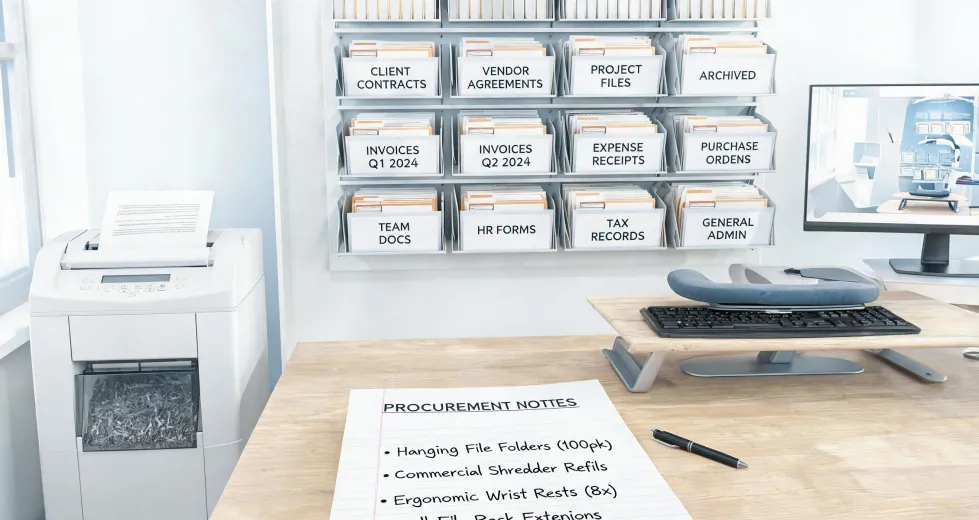
On a Tuesday in May 2024, I was kneeling in our supply room with a pair of tweezers, pulling damp paper scraps out of a jammed Fellowes paper shredder. That moment wasn't the real problem. The real problem started months earlier, when I approved an office equipment purchase based mostly on the price tag and never thought about what it would cost to keep running.
I handle purchasing and equipment orders for a 40-person consulting firm. I've done this work since 2019, and I keep a private log of mistakes. This one is entry fourteen. It wasn't the most expensive mistake, but it changed how I look at every supply order.
During the same week, I dealt with the wrong box of binding covers, a color print panic, and a printer that said offline. Each problem looked like an equipment failure. Each one was actually a failure in the way I compared prices.
The shredder wasn't the real problem
Our document shredder is a Fellowes paper shredder. I chose it because I wanted a durable machine for monthly audit cleanouts and end-of-year purges. It handled the paper volume without complaint. But I never oiled the cutters. I treated shredder oil as an optional accessory, not a requirement.
When I tried to shred a folder of old confidential documents, the machine jammed. My first thought was that we needed a new shredder. My second thought was to check the manual. I looked up 'how to clean Fellowes paper shredder' and found the exact steps I had skipped.
The instructions were not complicated: unplug the machine, remove the waste bin, pull out visible paper scraps, squeeze a line of shredder oil across the cutter entry, wait a few minutes, run in reverse, then test with a clean sheet of paper.
I followed that sequence. When the motor settled into a quieter, healthier sound, I realized the shredder had not broken. It had simply been dry. A twelve-dollar bottle of oil was the maintenance cost I had tried to avoid. Neglecting it almost caused me to spend several hundred dollars on a replacement that would have needed the same care.
The obvious story is that cheap equipment fails and quality equipment does not. It isn't that simple. Quality equipment still needs attention. Skipping attention will make either option unreliable. The real cost of a machine includes the time it takes to clean and maintain it.
At the time, I thought buying a good brand was the entire answer. A good brand buys you a stronger motor and better safety features. It does not buy you an exemption from routine care. I'd rather own one solid machine and maintain it than own a cheaper one and wonder when it will fail.
The covers that should have been simple
Two days later, the same office needed a board presentation packet. The job called for clear front covers and a crisp back cover, and my procurement list said Fellowes binding presentation covers. What sat in the supply cabinet was a cheaper box I had ordered during a budget-hold conversation. I knew the cheaper option wasn't as good, but I wanted to avoid another discussion about spend. It turned out to be a bad trade.
The cheaper covers were a different thickness. They didn't feed through the binding punch as evenly. One cracked when I tried to close the comb, forcing me to pull the document apart and start over. I spent the afternoon redoing pages that should have been done in an hour.
On Thursday morning I placed a small rush order for the correct Fellowes binding presentation covers. The nine dollars I had saved on the first box turned into eighteen dollars in shipping, plus about two hours of rework, plus the risk of missing a board-meeting deadline. The correct covers were not magic. They were consistent, and consistency is what matters when you are working under a deadline.
The photo printer I almost bought
The board packet also needed color product shots. Our office printer can handle color documents, but it is not a photo printer. Photos printed on standard copier paper looked dull. I had started to convince myself that we needed a dedicated photo printer for the marketing team. Then the printer status changed to offline.
With pages waiting, I searched 'how to get printer back online' and worked through the usual remedies. The fix was a stale job in the print queue. One laptop had gone to sleep while a document was still waiting to print, and that stuck job blocked the whole queue. I cleared the queue, woke the laptop, reconnected it to the office Wi-Fi, and sent the document again. It printed fine.
The day before, I had nearly sent a purchase request for a photo printer. It would not have solved the offline issue. It would have added another printer to maintain and another set of consumables to store. A photo printer might be justified if we produced printed marketing materials every week, but we don't yet. Buying one because a device said offline is solving the wrong problem.
This is where I started to see the pattern. A stale queue made the printer look broken. A dry cutter made the shredder look broken. Wrong covers made a simple binding project look hard. All three situations were caused by ignoring what happened after the purchase.
I made a note to myself: buying equipment by the category name is not enough. A photo printer is not automatically better than a document printer. And an office highlighter is not highlighter makeup, even though both carry the same word. I need to understand the job I am actually asking the product to do before I compare prices.
What I do differently now
The board packet eventually went out on time. It looked good. Part of me wants to end the story there, because the finished result was fine. Another part knows the stress was unnecessary and the fixes were easy. The only reason they felt hard was that I hadn't planned for maintenance, consumables, or behavior changes.
Now I keep a small bottle of oil on the shelf above the shredder. The calendar reminds me when the cutter should be oiled. The supply cabinet has a label that says which binding covers work with our punch, including the correct Fellowes model. Before I approve any office equipment purchase, I ask myself three questions: Does this solve the root cause or only the symptom? What does this cost to run, clean, and maintain over a year? And if I choose the low-price option, what rework or downtime might that create?
I don't always choose the famous brand. For some tasks, a basic product is good enough and the lower price is the right call. But I stopped pretending that comparing invoice totals was the same as comparing costs.
If you are the person in your office who orders supplies, I hope this saves you the same week. The purchase price is only the beginning. Read the manual before you need it. Keep the right covers in stock. Check the print queue before you order a new printer. And when you do the math, include your time.
In my office, that lesson cost about $400 after I counted the oil, the shipping, and the time. It could have cost much more if I had replaced the shredder and bought a photo printer that week. The cheapest decision is not always the one with the lowest ticket price.

Leave a practical note