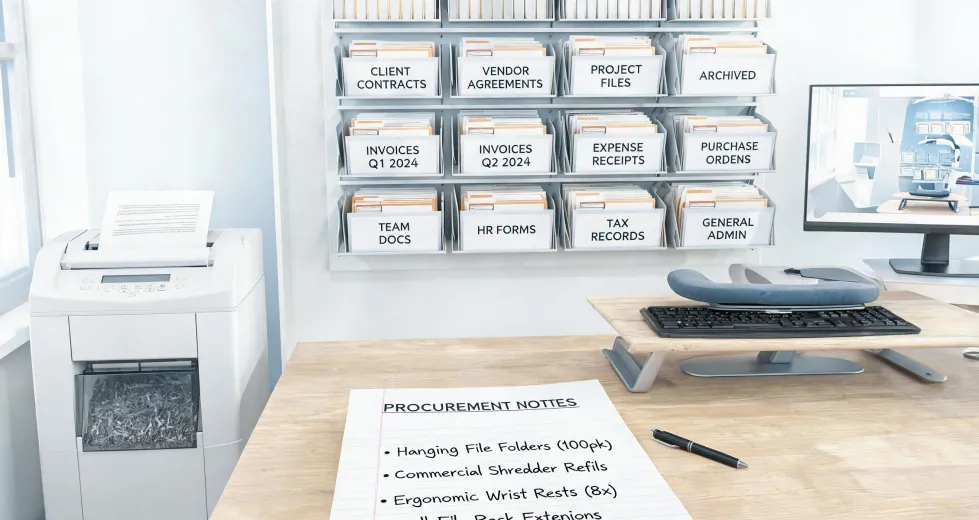
I didn't start my career caring about shredder duty cycles. Honestly, most admins don't. You care about whether things show up on time and whether the people around you can do their jobs. That's been my life for five years now—I'm an office administrator for a company of about 200 people spread over three floors. I manage roughly $180K a year in office spending across eight or nine vendors, everything from paper to furniture.
And the most surprising thing I've learned after all this time is that most “equipment failures” in our office were misuse, mismatch, or misunderstanding. The gear wasn't broken. We were using it wrong.
The surface problem: constant small annoyances
Every week, someone would come to my desk with the same complaints. The shredder is blinking red again. The printer is slow. This report I bound fell apart in my hands.
The one that drove everyone crazy was the Fellowes paper shredder red light. Finance would be mid-purge—clearing three months of old files—and the shredder would just stop. Red light blinking. No explanation. Conversations ground to a halt while someone tried to figure out the trick.
Sound familiar? When I first searched “fellowes paper shredder red light,” I figured the machine was dying. There's this assumption that a blinking red light means hardware failure, right? Actually, no. Not usually.
The deep cause: three mismatches hiding in plain sight
Here's something most people don't realize: the red light on a shredder is usually a safety feature, not a malfunction. It's thermal protection. When the machine overheats—because you're feeding it more than its duty cycle allows—it stops and refuses to restart until it cools down. It's not broken. It's protecting itself from us.
I read the manual for the Fellowes shredder after a year of angry finance people standing in my doorway. (I know, reading the manual—groundbreaking.) The spec says 12 sheets per pass, and the duty cycle assumes you'll let the machine rest between runs. Finance was feeding 25 sheets at a time under a quarterly deadline. We had two people clearing an entire file room on a Saturday. The machine wasn't failing. It was doing exactly what it was designed to do—refusing to set itself on fire because we asked too much of it.
The same pattern showed up with printers. We had one inkjet sitting in a common area. Everyone used it for everything—client contracts, envelopes, recognition certificates, random PDFs. At some point, the question of inkjet vs laser printer became a recurring office debate. Some people insisted we needed a laser. Others said the inkjet was fine—it just needed new cartridges “sometimes.” Meanwhile I'm looking at an $80/month ink cartridge bill.
The truth is, the inkjet wasn't a bad printer. It was the wrong tool. Inkjets are fine for low-volume printing, photos, occasional color documents. They're not designed for high-volume, text-focused office printing. Every time someone printed a 20-page contract on it, the ink consumption was ridiculous compared to what a laser would use. The cartridge was always running out, not because the printer was defective, but because we were using a pool car to haul freight.
And then there's the printer paper issue. Nobody thought about it. We grabbed whatever ream was cheapest at the office supply store. But paper isn't just paper—it's a genuinely technical product, and the specs matter more than most people realize.
What vendors won't tell you about paper
Paper weight, brightness, and finish change how your equipment behaves. A 20-lb, 84-brightness ream is a completely different experience from a 24-lb, 92-brightness sheet, even though both look like ordinary paper until you print on them. The lighter paper curls at the edges, especially after sitting in a humid supply closet. That curl causes printer jams, makes toner bond unevenly, and—as we discovered—completely wrecks shredder feeding.
Once we switched to 24-lb for document printing, our equipment issues dropped noticeably within a month. That's a real, observable improvement. Our facilities manager mentioned it unprompted, which basically never happens.
Here's the thing vendors won't tell you: the “premium paper” aisle exists because the cheap stuff costs more in the long run. It's not a markup scam. Shop by spec, not just by price per ream.
The real cost of getting it wrong
During our 2024 vendor consolidation project, I sat down and calculated what all these mismatches were actually costing us. I'm an admin. I like spreadsheets. So I made one.
The results were genuinely uncomfortable:
- Shredder downtime: Finance lost 40-50 minutes per week dealing with jams, cooldown waits, and walking to another floor to find a working shredder. That's over 30 hours per year. At a loaded cost of roughly $45 per hour for a senior analyst, that's about $1,400 of wasted salary. Maybe $1,700 if I'm being generous with the rate. Either way, it's money we were lighting on fire.
- Printer costs: The inkjet consumed roughly $80/month in cartridges. A comparable laser printer runs about $10/month in toner for equivalent volume—a difference of about $840 per year. The laser printer we bought in January 2025 cost $190 from our office supplier. Verify current pricing at your vendor; rates do fluctuate. It paid for itself in three months.
- The $2,400 mistake: In 2023, I bought a no-name shredder to save $180 against the Fellowes model I knew worked. I was trying to hit a departmental budget target, and it felt like a smart, frugal move at the time. It jammed constantly. The bin release popped open mid-cycle. The motor burned out after eight months. I bought the “expensive” one anyway, ate the $180, and that doesn't count the lost staff time fiddling with the cheap one for the better part of a year. The real cost was somewhere around $2,400. That's my stupid tax. I own it.
None of that includes the compliance angle. We handle employee records and financial documents, so confidential paper sits around until it's shredded. A broken shredder means sensitive documents waiting in an unlocked bin. That's a liability, not just an annoyance.
The moment it all clicked
What really changed how I think about equipment was a failed binder project in March 2023. My boss walked into a client meeting with a report I'd prepared—a financial summary bound with a Fellowes binder. The spine fell off. In front of the client.
Mortifying doesn't cover it.
I spent a week blaming the equipment, the paper, the binding machine—everything except myself. Then I finally watched a 3-minute tutorial on how to use a Fellowes binder, and I realized the error. The pages weren't seated properly in the punch alignment. The spine wasn't positioned squarely before closing. The equipment was functioning perfectly. I was using it wrong.
That was my trigger event. I stopped blaming machinery and started looking for operator error first. That shift alone has probably saved us thousands since then.
The savings bond calculator moment
One more example, because it's so oddly specific that it has to be true. Our payroll person still uses a savings bond calculator on TreasuryDirect to verify employee bond values. She printed a set of year-end valuation reports on the cheap paper because it was closest to the printer. Those pages curled at the edges. When we later shredded them for confidential disposal, the curl caused the shredder to jam on every fifth sheet. We blamed the shredder. Again.
The shredder was fine. The paper was the problem. A $5 difference per ream was causing $50 worth of frustration and wasted time every single month.
The fix: boring, basic, but it works
After all that, the solutions I'd offer to another admin are deliberately undramatic. No magic bullets. Just fundamentals:
- Read the specs before you buy. Capacity rating, duty cycle, recommended paper weight—it's all in the spec sheet. If you know your actual workload, you can match the machine to it. This alone solves most “equipment failures.”
- Match the machine to the workflow. Text-heavy, high-volume printing? Get a laser. Photos and occasional color? An inkjet is fine. That's the honest version of the “inkjet vs laser printer” comparison: it depends on your volume and document mix.
- Buy paper by spec, not just by price. Standardize on 24-lb, 92-brightness for anything client-facing. Keep cheap reams for internal scratch printing, but know the difference.
- Learn the basics. The manual isn't a suggestion. The tutorial videos on your equipment manufacturer's site are not a waste of time. They will save you from appearing foolish in front of a client. I can tell you from experience that's a feeling you don't want.
- Respect the limits. If you need to shred 500 pages a day, buy a machine rated for that volume—or contract with a shredding service. Just don't feed 25 sheets into a 12-sheet shredder and then wonder why it keeps stopping.
- Know your lane. I'm not an IT person. If someone asks me about PCL vs PostScript or network printer configuration, I'll say straight out: that's beyond me, here's the vendor who handles it. I'd rather send someone to a genuine specialist than pretend. And I think good suppliers do the same. The vendor who says “this isn't our strength—here's who does it better” earns my trust for everything else they sell us.
The bottom line: your office equipment probably isn't broken. It's being asked to work beyond its intended volume, fed the wrong supplies, or operated without basic training. All of that is fixable without replacing anything.
Start with the paper. Check the specs. Read the manual. And stop feeding 25 sheets into a 12-sheet shredder.
Your finance team will thank you.

Leave a practical note