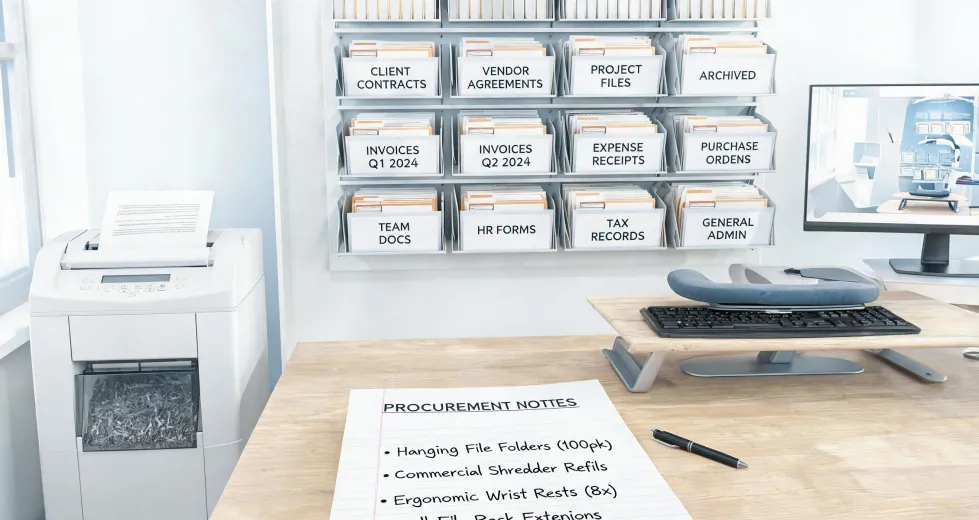
Here's the shortest version: the emergency plan for a busy office is not a faster vendor. It's the right machine, already in the building. In my role coordinating office equipment and document finishing for a regional supplier, I've handled 200+ rush orders in three years—including same-day turnarounds for law firms, schools, and event teams. The Fellowes 79Ci paper shredder, the Fellowes Helios 60 thermal binder, and a properly fitted ergonomic office chair solve more daily crises than any all-in-one service promise. From the outside, a rush order looks like the only question is speed. The reality is speed without the right machine just means you fail faster.
Why I'd protect the shredder first
When a confidentiality deadline hits, a shredder isn't a nice-to-have; it's a liability tool. In March 2024, a financial services client called at 2:30 in the afternoon. They had 180 boxes of client records that the auditors wanted destroyed before the next morning. We didn't have time to hire a destruction crew, and we didn't have space to wait for the scheduled pickup.
I don't have hard data on industry-wide shredder failure rates, but after watching three residential-grade shredders die on exactly this kind of job, my sense is that the motor matters more than the marketing. The Fellowes 79Ci is the model we place in any office that handles personally identifiable information. It's a cross-cut shredder built for sustained shredding sessions, not just a page here and there. The bin is big enough to keep going, and the feed system handles a stack without constant babysitting.
I won't say any machine is completely jam-proof, because someone will always feed it something it wasn't designed to eat. But the 79Ci's design is the reason I've lost fewer deadlines to paper jams than to elevator failures.
The thermal binder is the deadline's best friend
Later that year, a client called at 4:15 PM. They needed 26 bound proposals for a 9:00 AM investor meeting. The normal quote for outsourced binding was three to five business days, and the rush fee was $180 on top of an $850 order. The only other option was unbound paper, which in that context is the same as not showing up.
Instead, we used the Fellowes Helios 60 thermal binder. Thermal binding looks like it should be complicated and isn't. You drop the pages into a thermal cover, press the lid down, wait, and you have a professional document with a flat spine. I had all 26 proposals done before the coffee finished brewing. The client made the meeting, and we've kept the Helios 60 at the front desk ever since.
To be fair, thermal binding isn't right for every document. If you're producing a 300-page catalog, perfect binding is a better route. But for an urgent proposal, it's a no-brainer.
The real emergency: the chair that hurts
Nobody calls it an emergency when an employee's chair is wrong. My phone rings for shredders and binders first. But if we're honest about what actually disrupts an office, a bad chair is the slow emergency—or, more accurately, the quiet one nobody brings up until someone starts taking sick days. I don't have hard data on how many backaches turn into insurance claims, but our order log shows that seating is the item people try to save on first and ask us to replace most often.
An ergonomic office chair doesn't need to be a $900 throne. It needs to fit the person: seat depth, lumbar support, armrests, and enough adjustment range to survive a 10-hour deadline week. Based on publicly listed prices in Q1 2025, entry-level ergonomic chairs start around $150 before shipping and tax, and a mid-range chair with real adjustability usually lands somewhere between $400 and $700. If I'm buying for a new employee, I'd rather start with a Fellowes ergonomic chair and spend 10 minutes adjusting it than order a generic executive chair that only looks good in a photo.
Use a percent off calculator, then ignore the percent off
This sounds backwards, but I tell every client who asks about office furniture deals the same thing: a percent off calculator tells you the price of the chair, not the value of the chair.
Take two examples from last quarter. A $300 chair at 40% off is $180. Sounds like a win. A $640 Fellowes chair at 15% off is $544. The first one is a better-looking discount. But if the first chair doesn't have adjustable lumbar support and the second one does, the second one is cheaper in the only currency that matters: whether the person can still get up from their desk at the end of the day.
So yes, open a percent off calculator before you buy office equipment. Just use it to compare total cost—delivery, tax, warranty, and the likely return process. A discount is not a product strategy.
Before you hit order: what is normal printer paper size?
You'd think everyone knows this one until a rush print job goes sideways. In the US and Canada, the normal printer paper size is ANSI letter: 8.5 x 11 inches. In most of the rest of the world, the ISO 216 standard is A4: 210 x 297 millimeters. That makes A4 about 18 millimeters longer and 6 millimeters narrower. They're close enough to confuse people and different enough to jam a tray.
I learned this in 2022, when a client ordered 5,000 flyers on letter paper for a mailing run they had planned as A4. We caught it before the print run, but the difference between letter and A4 cost us a reprint and a delivery fee that nobody budgeted for.
When you're buying paper in bulk, check two things: the label printed on the tray and the setting in the printer driver. If the tray says LETTER, don't feed it A4. If the software says A4, don't assume the paper already in the tray matches. In an emergency, the 18-millimeter length difference is a deal-breaker.
The most useful phrase: 'this isn't our strength'
I have mixed feelings about one-stop shops. On one hand, one invoice and one contact is convenient. On the other, being a generalist often means being mediocre at the specialty moments that matter most.
That's why I trust suppliers who tell me when they're out of their lane. If I ask for a clinical ergonomic assessment and the seller says, 'We don't do that, but here's a specialist,' that seller just earned the next order for everything else. Knowing the boundary is not a sign of weakness; it's a sign of experience.
It's also why I keep Fellowes on my short list for shredding and binding specifically. They make specialized tools for a specific kind of office work, and they don't pretend a desktop shredder is the solution for a document destruction marathon. There is no single machine that does everything well. Admitting that is the most reliable thing I can offer a client.
One caveat: this advice assumes you're a small or mid-size office, not a 300-person operation with a facilities department and service contracts. If you have someone whose job is preventive maintenance, buy the service plans. For everyone else, start with the tool that would have solved your worst emergency last year—and get it before you need it.
Also, specs and prices I mentioned were current as of early 2025. Office equipment changes faster than people think, so verify the current models and warranty details before you commit.

Leave a practical note