-
Most office supply failures are ordering failures
-
Why I'm the one writing this
-
Mistake 1: Buying a shredder on price, not on specs
-
Mistake 2: Ignoring sales tax until the invoice arrived
-
Mistake 3: The cheap printer that was a trap
-
Mistake 4: 'Simple' tools still have a learning curve
-
Mistake 5: Trusting labels instead of specs
-
The checklist I wish I had in 2018
-
Where this advice stops being useful
Most office supply failures are ordering failures
Most office supply problems are not product failures. They're ordering failures. I know because I've been on both sides. For the past six years, I've handled office supply purchases for a 60-person team, and I've made about $4,300 in mistakes that a one-minute check would have caught. Here's the sentence I underline in every note I write: The cheapest product is not the cheapest once you add the time lost to jams, wrong specs, and tax surprises.
That sentence sounds obvious now. It didn't feel obvious when I was repacking a pile of returns, or explaining why the invoice was $224 higher than the approved purchase order. After the third big miss, I made a checklist. In the past 18 months, that checklist has caught 47 potential errors. That's not a brag. It's what happens when you stop trusting your first instinct and start verifying details.
Why I'm the one writing this
I'm not a purchasing director. I don't have a supply chain certification. I'm the person who ends up with the office supplies task because I'm organized and I don't lose receipts. That means I've learned the hard way. In 2018, I ordered 500 binders with the wrong spine width. That mistake cost $890 in reorders plus a one-week delay. In Q1 2024, I almost ordered ten times the quantity of desk pads because the vendor's unit size was 'package of 10' and I read it as 'one.' I caught that before I hit submit. So glad I did. You don't forget that feeling.
Mistake 1: Buying a shredder on price, not on specs
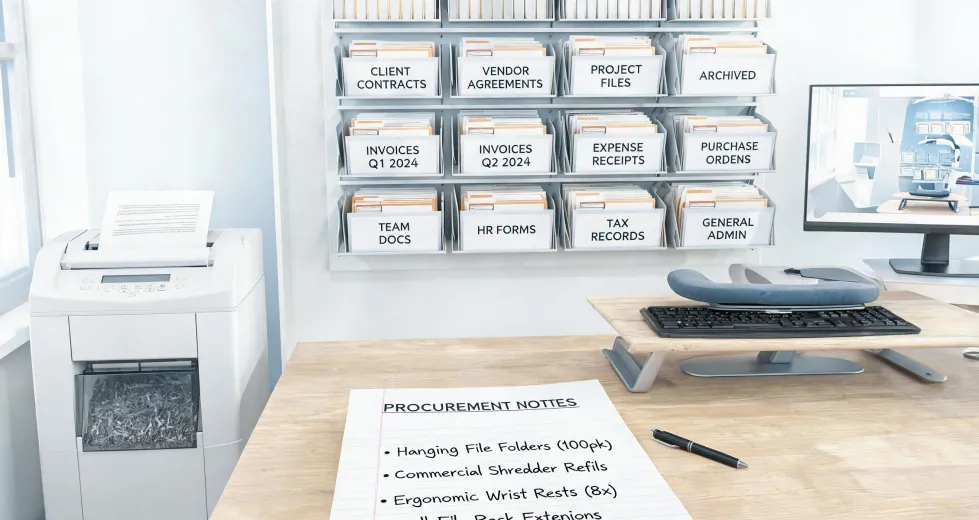
I used to think all shredders were basically the same. Then I bought a cheap unit that jammed if you looked at it wrong. It said 5-sheet capacity on the box, but realistically it handled three, maybe four, unless the paper was bone dry and perfectly aligned. I returned two shredders in one year before I finally listened to a colleague and tried Fellowes paper shredders. The one that ended up on our floor is the Fellowes Saturn 3i A4. It's not fancy, but it handles A4 paper without a fight. That's what we need.
The part I want to stress: even a good shredder has limits. The Saturn 3i A4 is built for small office use. If you're shredding old client files for two hours straight, you need something with a higher run time and bigger bin. I can only speak to normal loads. Check the sheet capacity, the run time, and the bin size before you buy. The machine that works for a team of 60 might not work for a team of 600.
Mistake 2: Ignoring sales tax until the invoice arrived
I told you about the $3,200 order where I forgot the tax. Let me rephrase that. I built a spreadsheet, itemized every desk and monitor arm, even added shipping. I left out sales tax. The invoice came in at $3,424. The extra $224 wasn't a disaster, but it was a credibility hit. I had to ask for more budget for a line I should have seen. I knew I should have double-checked the tax line, but I thought 'it's a standard rate.' That was the one time it wasn't.
Now I use a sales tax calculator before I send a PO. I enter the state and the amount, and I add the number to the total. If the vendor is in another state, I look up the rules. Some orders end up with use tax, not sales tax. I'm not a tax professional, but I've learned that verification beats assumptions.
Shipping also counts. According to USPS pricing effective January 2025, a First-Class Mail letter costs $0.73 (usps.com). That sounds small until you mail 200 letters. Postage alone is $146. Add the cost of envelopes, printing, and time, and the low-cost option looks different. Prices change, so verify current rates. The point is the same: include everything in the total.
Mistake 3: The cheap printer that was a trap
Now the one I should have known better about. I bought a compact color printer because the upfront price was $79. The brand isn't important—or rather, I can't remember the model, and that says a lot. I'll call it the cricket printer in my notes. The name sounded like something you'd use to print a cricket scorecard. Not a good reason to buy anything.
The cartridges cost about $55 each, and the printer used two colors at a time. Within a year, I had spent way more on ink than the printer cost. A printer is not a one-time purchase. It's a subscription with extra steps. Before you order any machine, look up the consumables: ink, toner, blades, oil, bags, or special paper. Add the first-year cost to the total. If that number still makes sense, fine. If not, you just saved yourself a mistake.
Mistake 4: 'Simple' tools still have a learning curve
This is the one that made me laugh at myself. I needed to help my daughter with math homework, and the paper had a protractor printed on it. I held it upside down for a solid minute before I admitted I had to look it up. At 9 pm, I searched for 'how to use a protractor.' The instructions were simple. I still felt silly.
The reason I include this in an office supply article is that I used to order things and assume the user would just know. That's wrong. A standing desk has instructions. A paper shredder has a manual. Even a protractor has a learning curve, apparently. If you add something new to the office, add a link to a how-to video or a quick setup guide. It saves the time that turns into frustration.
Mistake 5: Trusting labels instead of specs
I like a label that says 'heavy duty' as much as anyone. But labels are marketing. Per FTC guidelines (ftc.gov), advertising claims are supposed to be truthful and substantiated. That's good. It still doesn't mean the product will fit your situation. One 'adjustable' desk accessory I ordered had two height settings. Technically adjustable. Just not adjustable enough.
Now I ask for the full spec sheet in writing. If the vendor says 'heavy duty,' I ask for run time, weight limits, materials, and warranty terms. If they can't provide a clean answer, that's an answer. That one habit has saved me from at least three bad purchases.
The checklist I wish I had in 2018
Here is the version I use now. It's not a magic formula. It's just a way to slow down.
- Capacity and run time: What can this handle on a normal day, not the best-case day?
- Delivered price: What's the total with tax and shipping? Use a sales tax calculator if you need one.
- Consumables: What has to be replaced, and how much does that cost in the first year?
- Skill level: Who will use this, and do they have the training or instructions they need?
- Return policy: If it's wrong, how hard is it to send back?
The order matters less than the habit. I still skip the checklist for a box of pens. For anything over about $100, it's mandatory. Actually, it's mandatory for anything with a power cord or a manual.
Where this advice stops being useful
This checklist worked for us because we're a mid-size office with predictable orders. Your situation might be different. If you're buying for a school with safety codes, a warehouse with high-volume shredding, or a seasonal business with demand spikes, you'll need to adjust. I can only speak to my own experience. I've made a lot of mistakes, but I haven't made yours yet.
The best outcome from this article is that you avoid one $224 tax surprise or one $55 ink cartridge rage. That's real money. And if you remember one sentence, remember this: the cheapest product is not the cheapest once you add the time lost to jams, wrong specs, and tax surprises.

Leave a practical note