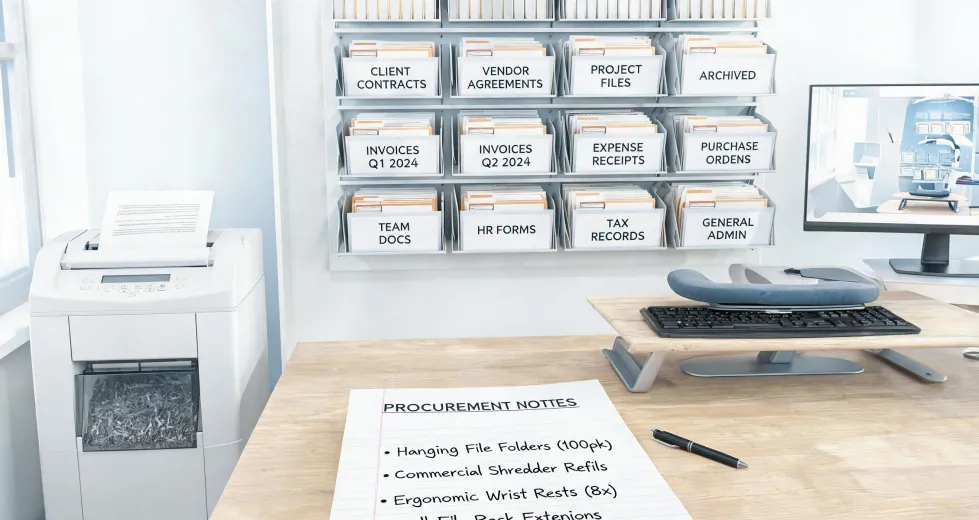
It was a Thursday at 2:47 PM when the phone rang. A facilities manager I'd worked with for years—let's call her Dana—had a problem. Her firm was moving into a new office on Saturday. The movers had disconnected everything, and a quick walkthrough revealed the situation was worse than expected: 16 desks with no keyboard trays, three shredders running on their last few bags, a file room with no label maker, and a printer that nobody could figure out how to add to the new network. Normal lead time for this kind of setup: five to seven days. We had 36 hours.
In my role coordinating office fit-outs for a mid-sized commercial furniture dealer, I've handled roughly 200 rush jobs in six years. I know the drill. But that didn't stop me from making the same mistake I'd made a dozen times before.
The mistake is thinking about what things cost instead of what they really cost.
The First Instinct: Save the Budget
Honestly, my first reaction was to protect the budget. Dana's client had already approved a change order, but I still wanted to come in under it. So I did what a lot of people do in a rush: I started looking for the lowest unit price. Cheap underdesk keyboard drawer? Sure. Off-brand shredder bags? They're just bags, right? A label maker without checking whether it came with tape? It said "label maker" on the box. And the printer—well, we'd figure out how to add printer settings once we were on site.
Everything I'd read about procurement said compare unit prices. In practice, I've found unit price is basically the least useful number on an invoice.
The first sign of trouble came when I tried to order the generic keyboard drawers. The photos looked fine, but the specs—when I finally found them buried in a Q&A section—said the mounting brackets were designed for flat-bottomed desks. Dana's new desks had a crossbar and a cable tray running underneath. The generic trays would have needed extra hardware, extra labor, and probably a trip to the hardware store at 7 AM on a Saturday morning.
I still kick myself for almost buying them. (Note to self: always check mounting compatibility before promising a 12-hour install.)
What "Cheaper" Actually Cost
Let me rephrase that: the generic keyboard drawer was cheaper by about $22 per unit. But by the time we added the adapter kit, the longer screws, the labor to improvise a bracket, and the risk that a desk would jam on the first try, it was actually more expensive than the Fellowes Office Suites underdesk keyboard drawer I ended up ordering.
The Fellowes unit fit the bay of the desk, mounted cleanly onto the crossbar, and had a sliding mechanism that didn't wobble. It also kept the keyboard at a comfortable angle—an ergonomic bonus I didn't expect. Our installer took less than ten minutes per desk. The first one always takes the longest, but by the fourth desk he had it down to six minutes. That's the kind of thing you don't see on a purchase order, but you definitely see it on the labor invoice.
The surprise wasn't the price difference. It was how much hidden value came with the option that fit the first time—no rework, no late-night hardware store trips, no "temporary" solutions that become permanent problems.
Same story with shredder bags. Dana's firm had three shredders: two strip-cut, one cross-cut. The off-brand "universal" bags were cheap, but they were also too tall for the shredder's internal bag frame, so they bunched up at the bottom and caused paper jams. One of them tore while being pulled out and dumped a surprisingly large pile of confetti onto the carpet. (Should mention: that was a Friday afternoon, and the only vacuum cleaner in the building was in a locked storage closet.)
Shredder capacity ratings assume standard office paper—20 lb bond = 75 gsm. That baseline helps, but the exact fit of the bag matters just as much. I replaced the generics with Fellowes paper shredder bags. They fit the frame properly, they held the same volume of shredded paper with room to tie the top, and the material was noticeably thicker. You don't notice that difference until a thin bag rips.
The cost difference per bag was maybe 15 cents. The cost of cleaning up shredded paper, running to a store mid-install, and losing an hour of installer time was somewhere in the "a ton of money I didn't want to spend" range.
The Label Maker That Taught Me to Read the Fine Print
Then there was the label maker. I grabbed a basic model because it was the cheapest one in the catalog. It didn't come with a starter cartridge. Let me rephrase that: the box said "label maker," but the small print said "label cartridges sold separately." By the time I paid for a cartridge, the price was higher than the bundle that included one. That's a classic total-cost trap.
If you're buying a label maker for an office, check the cartridge width, check whether the starter tape is included, and check whether the labels are compatible with the file folders you're using. A cheap label maker that needs an $18 label tape on day one isn't $29. It's $47. And if the labels peel off after a month, it's $47 plus the cost of redoing them.
The Printer, Because of Course It Was the Printer
And then there was the printer. Dana's IT person—who, between the boxes, had a browser tab open for a breeding calculator Palworld, because apparently that's the level of chaos we were operating at—said the printer was "already on the network." It was not. We spent 40 minutes googling "how to add printer" for the third time before realizing the driver wasn't installed on any of the new laptops.
In hindsight, I should have sent the driver link to Dana's team before we arrived. At the time, I didn't even know which model printer was coming. That's on me. The fix itself took five minutes once we had the right driver.
The Result
We delivered the office at 4:30 PM on Friday. That gave Dana's team the evening and Saturday morning to settle in before the Monday start. The law firm avoided what would have been a very awkward first day for new hires. And I avoided the $50,000 penalty clause in their lease—not that I would have paid it, but a delay would have meant a very unpleasant conversation.
Here's what I didn't do: I didn't pat myself on the back. Because the only reason it worked was that I'd learned the hard way in earlier rush orders. Looking back, I should have skipped the generic options from the start. At the time, the savings seemed worth the risk. They weren't.
Total Cost of Ownership: The Only Question That Matters
After six years and 200+ rush orders, I've come to believe that total cost of ownership is the only way to buy anything for an office. The unit price is just the entry ticket. The real costs are:
- Shipping and handling—especially when standard shipping becomes next-day shipping.
- Setup and installation labor—a product that fits saves time, and time is money.
- Rework and replacement—the cheap bag that tears, the tray that doesn't fit, the label that peels.
- Downtime—every hour the office isn't working is an hour of risk.
The $500 quote turned into $800 after shipping, setup, and revision fees. The $650 all-inclusive quote was actually cheaper. I now calculate TCO before comparing any vendor quotes.
Does that mean I always buy the premium option? No. It means I ask better questions: Does this fit the actual desk? Does the shredder bag come in the right size? Does the label maker include tape? Is the driver installed on the network? Sometimes the budget option is genuinely fine. But the decision has to be based on total cost, not the sticker price.
What I'd Do Differently (and What I'd Do the Same)
If I could redo that week, I'd spend ten more minutes on specs and one less hour on support calls. I'd also start with Fellowes Office Suites underdesk keyboard drawer, Fellowes paper shredder bags, a label maker with a starter cartridge, and a printer driver sent in advance.
Now my team has a simple rule for any rush job: confirm the desk underside, the shredder model, the label tape width, and the printer driver before the quote goes out. It's not sexy, but it saves days.
And if you ever find yourself searching for "how to add printer" at 9 PM while someone in the next room is asking about a breeding calculator Palworld—take a breath. You'll get through it. Just make sure you're using the right shredder bags when you do.

Leave a practical note