-
What "best equipment" actually means (and why it depends)
-
Scenario 1 — Your team lives in paper
-
Scenario 2 — Your team makes things, not memos
-
Scenario 3 — Your office includes a yard, dock, or warehouse
-
Scenario 4 — Your team paints, patches, and maintains
-
How to figure out which scenario you're actually in
What "best equipment" actually means (and why it depends)
Over the past six years, I've approved somewhere around $180,000 in office and facility equipment purchases, compared quotes across dozens of vendors, and stopped trusting the "must-have" lists that land in my inbox every quarter. (Half of those lists are written by people who have never reconciled an invoice in their lives.) The uncomfortable truth about buying equipment for a workplace: there's no universal right answer. What makes sense for a paperwork-heavy law firm would be wasteful for a product prototyping studio. So instead of serving you a generic "best equipment" roundup, I'll break down the four scenarios I actually encounter in my role, what I'd approve in each — and, this is the part most purchasing guides skip, what you should absolutely not buy.
Scenario 1 — Your team lives in paper
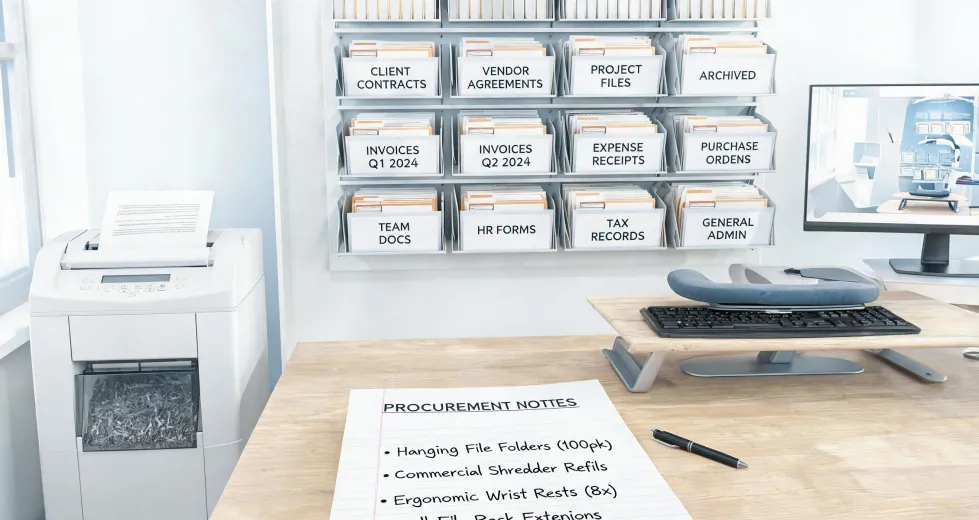
If your office generates contracts, invoices, client files, or any document with personal data, document handling is not optional spending. Two pieces of equipment earn their keep here: a secure paper shredder and a manual comb binding machine.
Let's talk about the shredder first. It isn't a luxury; per the FTC's Disposal Rule, businesses holding consumer information must take reasonable measures to protect it — and that includes physical documents (ftc.gov). If you're still accepting signed forms, you need a line item for shredding. Also, as a practical matter, confidentially discarded paper keeps your office tidier, though I don't recommend pitching cleanliness as the primary ROI.
When people search for paper shredder fellowes troubleshooting, the issues they describe are rarely about actual equipment failure. The "jammed shredder" complaint is almost always overfeeding — stuffing in more sheets than the rated capacity, or one sheet folding its corner and wedging sideways. The "stopped mid-feed" issue is often a thermal overload: the motor heated up, tripped the reset, and needs 20–30 minutes to cool down. I'm not a shredder technician, so I can't walk you through motor repairs — but from a procurement perspective, the fix is usually to clear the jam, let it cool, and next time feed the number of sheets the manual specifies. The equipment isn't fragile; it's being asked to exceed its design limit.
One thing that surprised me over the years: most teams don't need a high-security micro-cut shredder. Unless your industry carries a specific compliance requirement (think HIPAA or GLBA), a standard cross-cut model is sufficient. I once approved a micro-cut upgrade because the request said "maximum security." Looking back, I should have asked what regulation they were satisfying before spending the difference. At the time, "maximum security" sounded like a safe yes. It was not a disastrous purchase, but it was an unnecessary one, and those are the purchases that quietly eat budgets.
On the binding side, the "how to use fellowes binder star 150" question is more straightforward than people expect. The Fellowes Star 150 is a manual comb binding machine. You align your pages against the adjustable back gauge, pull the punch handle to create holes along the edge, fit a plastic comb onto the comb holder, slide the punched pages onto the comb's tines, then lift the comb out and snap it shut around the document. Two steps: punch, then bind. The "150" in the name refers to the maximum sheet count with a large comb, which you buy separately — nobody remembers to budget for the combs until the first order, and then suddenly a $130 machine demands $40 in consumables.
From a total cost-of-ownership view, I'd rather buy a mid-range Fellowes binding machine once than pay a print shop $4–6 per document every time someone needs a proposal bound. At fifty bound documents a year, that's $200–300 in savings annually. In Q2 2024, we applied this calculation to our own document finishing workflow and cut costs by 61%. If you're mailing those bound proposals, remember USPS flat-size thickness limits: a 3/8" or 1/2" comb stays under the 0.75" maximum, but a thicker comb puts you into parcel pricing (usps.com). Small detail, but it shows up on the shipping ledger.
Scenario 2 — Your team makes things, not memos
This is where a resin printer enters the picture. Usually it appears as a nicely designed "productivity investment" PDF from a team lead, and honestly, resin printers are impressive pieces of kit. They've compressed three-week waits for external prototypes into overnight internal iterations for a lot of small design teams.
But here's what those PDFs never include: the true cost of resin printing isn't the printer. It's the isopropyl alcohol bath for washing prints, the curing station, the disposable gloves, the UV resin refills, and the ventilation setup. I've watched a product team burn through $300–500 in consumables in the first two months, on a printer that cost $250. That's the exact kind of hidden cost that led me to build a procurement cost calculator in the first place.
When does a resin printer make sense? If your team is actively designing physical products — jewelry, dental models, mechanical parts — meaning the prototype budget already exists and the printer simply compresses the timeline. In 2024, we tested one for six months with a small product team, and it repaid its cost within four months by eliminating outsourced prototype fees.
When does it not make sense? If you just want to print the occasional custom widget. The setup, cleanup, and post-processing will eat an entire afternoon in exchange for a part you could have ordered for nine dollars. I'll say the quiet part out loud: that budget resin printer is a $900 machine once you buy a year's worth of consumables. It's also the messiest purchase I manage — gloves, masks, resin spills — and it is not a fit for a "we might use this occasionally" department.
Scenario 3 — Your office includes a yard, dock, or warehouse
This one surprises people, but facility teams come through our procurement office regularly, and the request that lands on my desk more often than you'd think is an outdoor storage box. I used to roll my eyes at that line item. I don't anymore.
If you keep outdoor maintenance equipment, seasonal decor, or deliveries that can't come indoors, a plastic resin storage box protects those assets from weather and theft in a way that a tarp cannot. From a procurement view, the cheapest tarp costs $40 and fails within nine months. A UV-stabilized storage box with a locking hasp runs $90–200 and lasts for years if it sits on level ground. I'm not a facilities engineer, so I can't speak to commercial-grade load ratings — but I can tell you the buying logic is identical to every other equipment decision we make: compare total cost across the product's lifespan, not the sticker price.
Where I draw the line: if you're storing electronics, documents, or anything humidity-sensitive, an outdoor box is the wrong answer. Mold doesn't care about your warranty. That's not a product flaw; it's a scenario mismatch, and scenario mismatches are where budget goes to die.
Scenario 4 — Your team paints, patches, and maintains
Paint is one of those "small" budget lines that escapes scrutiny until someone files a purchase order for five gallons at once. Then the question appears: oil vs acrylic paint?
From a total cost perspective, acrylic paint wins for interior touch-ups, and the margin is bigger than most people assume. Acrylic dries in hours, cleans up with soap and water, and doesn't require a team member to spend labor hours on solvent cleanup. Labor time is money, and water-based cleanup saves both.
This is also the place where my own experience contradicts the conventional wisdom. Everything I'd read growing up said oil-based paint is the only thing worth using on surfaces that take wear. In practice, across three facility projects in the last five years, modern acrylic formulations performed almost identically to oil on interior walls and trim. The durability gap has narrowed enough that I'll approve acrylic every time for interiors and not lose sleep.
Oil-based paint still earns its place outdoors. For exterior wood — doors, siding, railings — oil penetrates deeper and handles temperature swings better, which extends the recoat cycle. And when you account for labor, the recoat cycle is where the real cost sits. If oil gives you two years before repainting versus one year with acrylic, the oil is cheaper in the long run despite the higher gallon price and the mineral spirits cleanup. Select on lifecycle cost, not on "per gallon" sticker shock.
(One regulatory footnote: verify your local rules on oil-based paint disposal before starting. Leftover oil paint is hazardous household waste in many jurisdictions, and the fines don't care that you "only had one can." I nearly learned this the hard way — check, then paint.)
How to figure out which scenario you're actually in
If you've read this far, you've probably already recognized yourself in one or two of these. But in case you haven't, here's the simple test I use when reviewing budget requests:
- Do you process documents with client or customer data? → Scenario 1. You need shredding and binding capacity. You do not need a resin printer.
- Do you produce more than ten physical prototypes or custom parts per year? → Scenario 2. The printer earns its cost. If it's fewer than ten, an external print service is cheaper — no consumables, no gloves, no ventilation setup.
- Do you store anything outside for more than one season? → Scenario 3. Buy the box. If not, skip it.
- Do you maintain buildings, woodwork, or outdoor surfaces at least twice a year? → Scenario 4. Use the lifecycle paint logic. If you're a desk-only team, you'll never need this.
The honest limitation, and the point I want to leave you with, is that "best equipment" doesn't exist. The best purchase is the one that matches your actual workflow, and the second-best purchase is the one you skip because you knew the first one wouldn't fit. A satellite office once dropped $1,200 on a commercial espresso machine that required an out-of-state technician for every service call; it made four lattes in fourteen months. I'd rather approve a modest purchase that gets used daily than a flagship purchase that gets used once.
Prices referenced above are as of Q1 2025. Equipment markets change quickly, so verify current rates before you commit the budget.

Leave a practical note