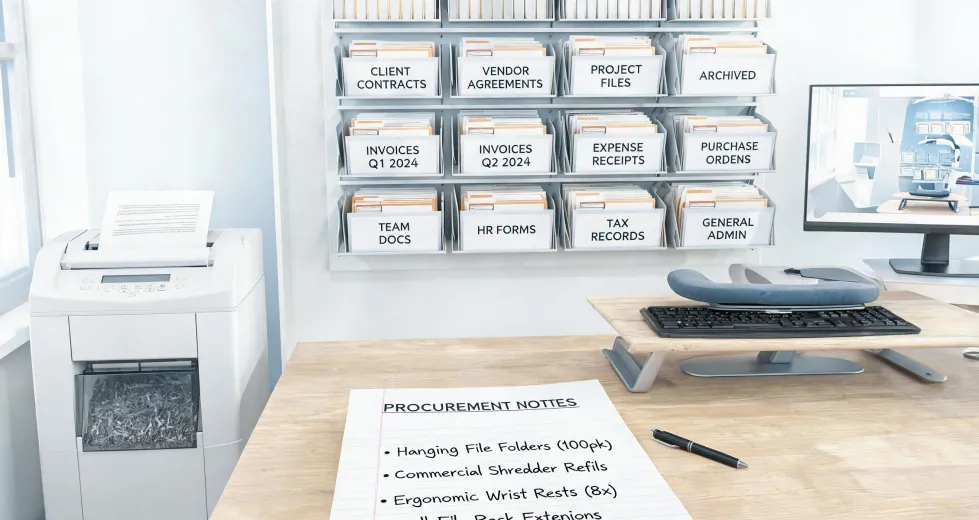
Let me save you some scrolling. If you're here because you're comparing Fellowes binders with a Fellowes paper shredder for home, the product list isn't your problem. The real question is what paper does in your home office—day to day and under deadline pressure. Those answers aren't the same for everyone.
I coordinate production at a B2B marketing agency. In eight years, I've handled more than 300 rush requests: last-minute proposals, misprinted event materials, tax folders needed by morning. Once you've spent enough time around deadline emergencies, you stop looking at product categories and start looking at workflows. That's what this guide does. No top-five lists. No universal "one best product." Instead, three scenarios. Find yours.
Type 1: You're a keeper—start with a Fellowes paper shredder for home
You keep old bank statements, client contracts, medical records, and receipts because you might need them someday. You're not a hoarder; you're cautious. But the pile has grown so dense that you can't find the one paper you actually need.
If that sounds familiar, your priority is destruction, not storage. The best move is a Fellowes paper shredder for home—not because shredding is digital-era paranoia, but because shredding is how you clear away the layers of outdated paper so the important stuff becomes visible.
When I'm triaging a rush order, the first thing I ask is what the person is keeping that they don't need. In 2023, an account manager at our agency nearly missed a compliance deadline because the signed form she needed was buried under two years of printed internal memos. The form existed. It had already been scanned. The paper stack made it invisible.
Here's something most people don't realize: a home shredder doesn't have to be expensive to be secure. For most household documents, a cross-cut model rated P-4 is enough. If you're shredding tax returns or anything with account numbers, step up to a micro-cut P-5—the smaller particle size means less risk of reassembly. And don't ignore runtime. If you're clearing a backlog, a shredder that stops after five minutes will frustrate you into not using it.
Short version: if old documents make you nervous, buy the shredder first. You'll clear the mental load along with the paper.
One caveat: don't shred everything. You still want a binder for current-year documents that you actively reference. That's not a contradiction—it's the same instinct pointed at a different layer of paper. I'd rather see you shred last year's files and bind this year's than do it the other way around. It's the difference between keeping things and keeping things findable.
Type 2: Deadlines are the boss—Fellowes binders earn their place
This is the scenario I live with weekly. You create proposals, pitch books, training manuals, or event materials. The work isn't judged only by what it says; it's also judged by whether it looks professional, organized, and ready under a tight clock.
If that's you, Fellowes binders are the better investment. Actually, let me be more specific: a binding system is, because you're not binding once. You're binding on a recurring cycle, and each deadline is a new production run.
In March 2024, one of our clients had 30 investor books due the next morning at 8 a.m. The local print and copy shop quoted the job at $320 including a same-day surcharge. A week earlier, they'd almost donated their tabletop Fellowes comb binder during an office purge. Instead, they spent $28 on covers and binding elements, ran the job at home, and had the books ready by 11 p.m.
Did that binder pay for itself that night? Based on that one order, yes. But I'm not going to tell you to buy one just in case. That's how you end up with equipment you use twice a year. The math only works when the deadline pattern is recurring.
What most people get wrong is assuming the big print shop is the only professional option. In practice, commercial printers build buffer into their standard turnaround so they can manage their production queue. A "three-day job" often ships in one day when the schedule is clear. But on days when the queue is full, no amount of polite asking will speed things up. That's when owning the right binder or binding machine is worth more than a coupon code.
If you're comparing options, think about how the document needs to be read. Comb binding lies flat and lets you open the element to add or remove pages, which is useful for edits and updates. Wire binding looks cleaner for polished client deliverables, but the equipment is typically a bigger investment. As a reference point, next-business-day rush service at major online printers usually adds 50–100% to standard cost, and same-day options—where they exist—can add 100–200% (based on major online printer fee structures, early 2025; verify current rates). At those numbers, a mid-range Fellowes binding machine starts to make sense as soon as you're producing even a few bound documents per quarter.
It's not glamorous. It's arithmetic.
Type 3: You print and preserve—photo printer projects, portfolios, and schoolwork
This scenario is for people whose paper problem isn't about presentation or destruction. It's about keeping and finding things later.
Maybe you have a photo printer because you're a photographer, a real estate agent, or a parent who still believes in printed memories. Or maybe you're a student trying to keep semester notes organized, with a grade average calculator tab open in another browser because you're worried about the final. These situations look different, but the workflow underneath is the same: you print, you keep, and you need to retrieve.
This is where I get pushback, because people assume students and home creatives should buy the cheapest supplies. Cheap supplies fail at the worst moments: the binder spine cracks, the sheet protector tears, and the stack ends up loose in a box again. If you're keeping something at all, you're keeping it because you might need it without warning. That's exactly when flimsy organization fails.
A sturdy Fellowes binder with clear sheet protectors is the simplest fix. For a student, use one binder per subject, not one binder for everything. If you're the type of person who opens a grade average calculator at the end of the term, you already understand that small points matter. Small amounts of disorder cost you in the same way—ten minutes of searching for a handout before an exam is ten minutes you don't have.
For photo printer owners, the rule is the same. Printed photos belong in page protectors, not in a cardboard box under the desk. The investment is small. The alternative is photos that fade, stick together, or get recycled during a misguided deep-clean. I made that exact mistake with a stack of event photos early in my career. The dollar cost was minor. The client moment was gone, and you don't get that back.
How to tell which type you are in the next two minutes
If you're still unsure, ignore the product specs and look at your recent history. Think about the last time a document caused you real stress:
- Were you worried about keeping something you shouldn't have—old bank records, a signed contract, account numbers sitting in a drawer? That's Type 1. Get a shredder.
- Were you staring at a printed deliverable that needed to look polished and professional by a hard deadline? That's Type 2. Get a binding solution.
- Were you digging through a drawer for a printed photo, a warranty, or a class handout while the clock ran? That's Type 3. Get a binder system.
Before you buy equipment, do the kind of math you'd run with a rent vs buy calculator. Count how many times per year you'll actually use the machine. Divide the purchase price by that number. If the cost per use is close to—or lower than—what an outside service would charge, you have permission to buy. If not, keep the print shop or shredding event on speed dial.
What was best practice in 2020 doesn't necessarily apply in 2025. The home office has matured. A good workspace needs more than a standing desk and a decent chair; it needs a working document lifecycle: a way to organize current material, present it when it matters, and destroy it when it's obsolete. The fundamentals haven't changed. The execution can always improve.
And if your current setup can't survive a 24-hour emergency, now is the right time to change that.

Leave a practical note