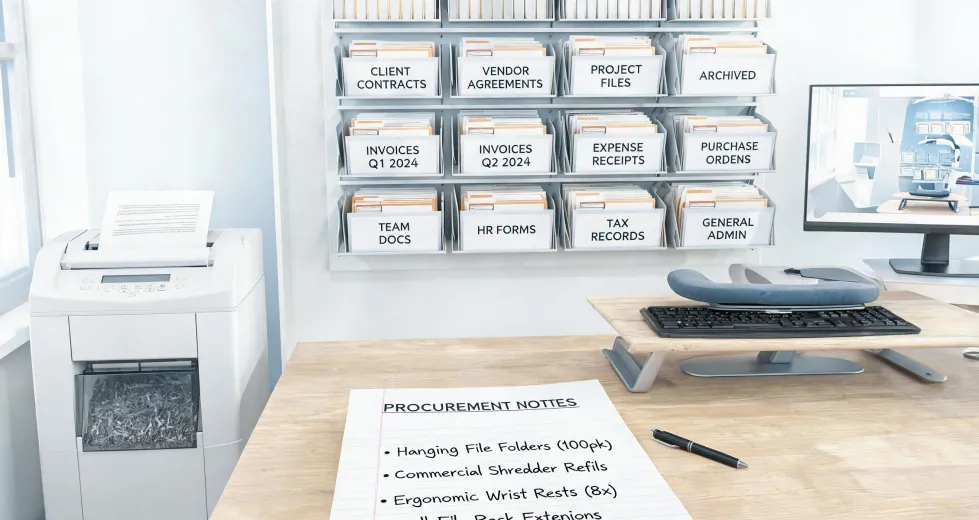
If you've been comparing the Fellowes paper shredder 60Cs with a Fellowes heavy duty paper shredder, you've probably noticed the spec sheets look clean. What they don't tell you is how both options behave when real people feed real documents into them for weeks at a time.
I manage procurement for a 60-person marketing agency. I've managed our office services budget of about $45,000 a year for seven years, negotiated with 12+ vendors, and documented every order in our cost tracking system. So let me walk you through the comparison I actually use when a manager asks me which shredder to buy: duty cycle, security, total cost, and hidden operational costs.
The Fellowes 60Cs vs heavy-duty decision kept me up at night once. On paper, the smaller machine made sense. But my gut said we'd outgrow it quickly. That gut feeling was right, but not for the reason I expected.
The comparison framework I use
Before I compare any machines, I set four criteria:
- Volume and duty cycle
- Security level required
- Total cost of ownership
- Hidden operational costs
I'm not going to tell you there is one perfect Fellowes shredder. I will tell you which one I would buy for your situation, and where I would draw the line.
That last part matters. If you only compare price, you'll miss the main reason offices replace shredders: the cheap machine sits idle during the exact moment you need it.
Volume: more than how many pages
The 60Cs is a desk-side shredder. It's designed for one person or a small team. A heavy-duty model is built to run longer and handle bigger batches. From a cost perspective, desk-side and heavy-duty should shape your decision more than any promo code.
If you shred a few pages after a meeting, the 60Cs is enough. If you shred client offboarding files, old invoices, and monthly reconciliation records, you need something that can keep going without a cooldown break. I've watched a team feed month-end paperwork into a 60Cs and then stand around waiting for it to cool down. That's not a product failure. It's a duty-cycle mismatch.
The only-large-companies-need-heavy-duty thinking comes from an era when shredders were used for annual archive cleanup. That's changed. Now every client agreement includes a data-disposal clause, so shredding is a regular task, not an end-of-year one.
Security: cross-cut is not always enough
The 60Cs is a cross-cut shredder. That's a big upgrade from strip-cut, but cross-cut is not a security level. If your clients just need reasonable destruction, P-4 particles from the 60Cs are usually fine. If your contract says micro-cut or P-5, you need to look at the Fellowes heavy duty line.
When I audited our 2023 spending, I found our secure disposal policy was actually a vague email from HR. After we standardized on a shred-size requirement, the machine choice got a lot easier. That's a paperwork fix, but it saved us from buying the wrong equipment.
One spec that trips people up: sheet capacity is based on 20 lb bond paper, which is about 75 gsm. If you are feeding 24 lb letterhead, which is 90 gsm, you need to cut the sheet count. The 60Cs may handle 10 sheets of standard copy paper, but that does not mean 10 sheets of thick stationery. Heavy-duty models have more buffer, but the same math applies.
Total cost: use a percent off calculator, then look deeper
I never look at a sale price without opening a percent off calculator. Say a heavy-duty model lists at $600 and a 15% off promo brings it to about $510. Meanwhile, a 60Cs at $180 looks like the obvious winner. But if the lower-cost unit slows down a three-person team every week, the real cost is labor, not the sticker price.
Take it from someone who has tracked every invoice for seven years: discount math is the easy part. The hard part is estimating the cost of waiting. If your loaded labor rate is $40 an hour and a slower shredder costs your team 15 extra minutes a week, that is about $520 a year. The heavy-duty model can pay for itself faster than you'd think.
The surprise was not the price difference between the 60Cs and the heavy-duty option. It was how many of our budget overruns came from cheap machines failing at busy times. We switched our operations team to a heavy-duty model after two jam incidents in one week. I should add that the 60Cs still works fine on the executive floor, where it's the right tool for a much lower volume.
How to add a printer: the cost side of setup
If you search how to add a printer, you get the quick steps: Settings, Printers & scanners, Add a printer, wait for the driver. That's fine from an IT side. From a budget side, I add a few more steps: estimate setup time, count consumables, and confirm whether the printer is shared or personal.
When someone asks me how to add a printer to the network, I ask three questions first: Is it USB or Wi-Fi? Who needs access? And what does it cost per page? None of those show up in the OS wizard, but they all show up in the annual budget.
That's where most printer cost surprises come from. A printer can be set up in ten minutes, but if the wrong driver version causes a half-day delay, the labor cost exceeds the hardware. Treating printer setup as a cost event, not just a technical task, keeps the budget honest.
Why a mulch calculator helped me pick a shredder
This one sounds odd, but it worked. A mulch calculator is designed for landscaping: you enter length, width, and depth and get cubic yards of mulch. The same volume math applies when you estimate how much shredded paper your team produces.
Why does that matter? The 60Cs has a smaller bin than a heavy-duty shredder. If your team shreds two cubic feet of material a day, someone is going to empty the bin a lot. That is labor. In our office, I used a mulch calculator to estimate quarterly shredded-paper volume for our recycling pickup. That number made the 60Cs vs heavy-duty decision much clearer: fewer empties, less time wasted, lower total cost.
A mulch calculator may not be the first tool you'd expect in an office supplies buying guide, but it's a great example of using the right unit of measure. Cost controllers do not guess. We calculate volume, time, and price with the same tools.
Which Fellowes should you choose?
If you are a solo consultant or a small office with occasional shredding, the Fellowes 60Cs is probably the right call. It's compact, priced for lighter use, and its cross-cut security is enough for ordinary business documents. I recommend it for that scenario without hesitation.
If you're an office manager with a daily pile of paperwork, go heavy duty. The larger bin, longer run time, and higher sheet capacity are worth the upgrade when the shredder is part of your workflow, not an afterthought.
Here's the honest limitation: neither model is right for a centralized records department with strict regulatory requirements. If your compliance team demands NAID-certified destruction, hire a shredding service. A shredder cannot give you a custody chain and a certificate of destruction. I say this because missing that requirement costs far more than any machine.
So use a percent off calculator to understand the sale, a mulch calculator to understand the waste process, and an honest look at your workflow before you buy. Compare deliberately, and you'll land on the right Fellowes for the right reason.

Leave a practical note