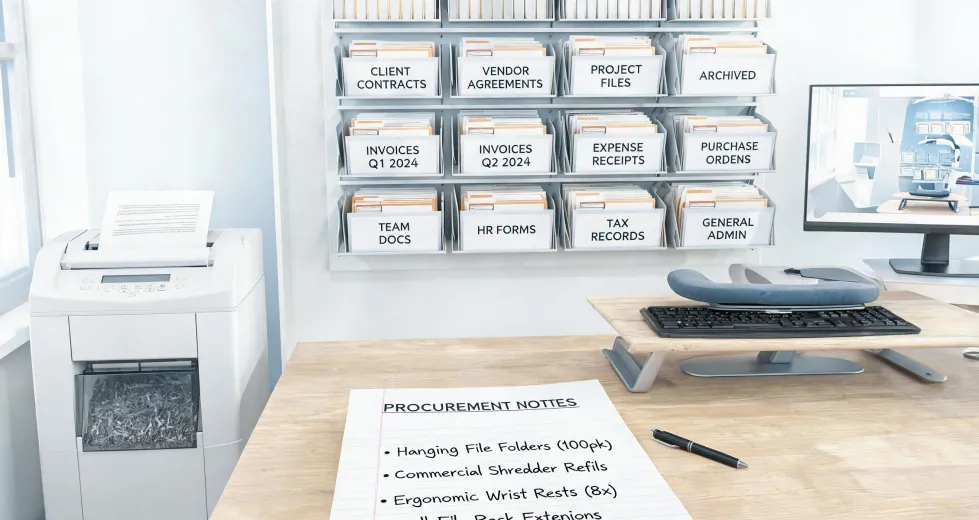
In 2023, I opened my cost-tracking spreadsheet and noticed something I couldn't ignore. We had spent $12,600 on office equipment repairs and replacements. And that number didn't include the hours people spent waiting for a printer to work.
I manage procurement for a 40-person manufacturing company. Over six years, I've tracked about $180,000 in office operations spending, compared quotes from more vendors than I can count, and built a cost model that now catches overruns before they happen. But it didn't start out that way.
This is the story of how I stopped blaming my budget and started looking at the machines.
Why the Office Always Needs 'Something'
Here's the surface problem. The shredder jams. The binder punches halfway through. The printer won't show up on the network. Someone says, 'We need a new one.' And because no one has time to troubleshoot, we buy new equipment.
That pattern is expensive. But it's not a budgeting problem. It's a thinking problem.
The deeper issue is that most of us buy equipment the way we buy lightbulbs. When it fails, we replace it with whatever is on sale. Lightbulbs have one job. Office machines don't.
What I Used to Believe (and What Changed)
I assumed that a higher price tag meant a better machine. Didn't verify. Turned out one of our most expensive purchases sat in a corner for six months because the people who needed to use it found the setup too confusing.
I also assumed that office equipment is pretty much the same across brands. That's the kind of assumption that costs you over and over. The real difference is in consumables, maintenance, and support.
I still kick myself for not figuring this out earlier. If I'd paid attention to cost per job instead of list price, we'd have avoided at least two failed purchases.
The Real Problem: We're Buying Price, Not Cost
Let me give you a simple example. A $99 shredder might last 18 months in a busy office. A $350 shredder might last 6 years. If you only look at the invoice, the first choice wins. But if you look at the math:
- $99 / 1.5 years = $66 per year
- $350 / 6 years = $58 per year
The 'expensive' shredder is cheaper over time. You don't need a quadratic formula calculator to see that. The equation is just total cost divided by useful life. That's it.
The same thinking applies to everything. A low-cost printer with expensive ink and frequent paper jams can cost twice as much per page as a mid-range printer with reliable drivers. A DTF printer in a side business can look like a good idea until you add up film, ink, and wasted transfers. The machine price is the entry fee, not the cost.
This is where most procurement advice gets it wrong. They tell you to compare features and reviews. That's important. But the real decision has to be about total cost of ownership, not the one-time purchase.
The Hidden Cost of Support
People don't include support in the TCO equation because support doesn't show up on an invoice. But it shows up on timesheets.
Ask any IT person what eats their week. They won't say 'big migrations.' They'll say 'small stuff.' Like the recurring question of how to add printer to mac. Every time someone searches for that, it's 15 or 20 minutes of lost time. Multiply that over dozens of people in a year and it's a real line item.
When I started comparing equipment, I began asking: Is this easy to add to a Mac? Does it have one driver for the whole office? Or do I need to fuss with settings every time? Those questions are boring. They also save more money than any rebate.
Ignoring Maintenance Is a Slow Leak
One of my biggest regrets? Not scheduling shredder maintenance sooner.
Shredders are simple machines, but they need lubrication. If you're smart, you'll search for how to oil Fellowes paper shredder before you search for 'new shredder prices.' The whole process takes five minutes. Skipping it means overheated motors, dull blades, and eventually a machine that dies in the middle of a security cleanout.
We saw this happen in 2024. Our main shredder started making a high-pitched noise. We ignored it for a week. Then it stopped. When I calculated the replacement cost and the two days we lost waiting for a new unit, it was more than triple what preventive oiling would have cost.
I have mixed feelings about maintenance contracts. On one hand, some are a waste of money. On the other, I've seen a $2,000 binder become a paperweight because nobody had the manual or parts. There's a middle ground: buy reliable machines and create your own simple care schedule.
What Ignoring These Problems Actually Costs
Let me be specific about my company. In 2023, the breakdown of that $12,600 was roughly:
- 40% replacements of equipment that could have lasted longer
- 35% repairs from misuse or lack of maintenance
- 15% consumables bought at full price because we ran out mid-project
- 10% freight and expedited shipping we wouldn't have needed with a plan
That's a conservative estimate. It doesn't include the 60 hours of staff time spent on printer problems or the anxiety of the 'will it jam?' moment during a client deadline.
The real cost of cheap or mismatched equipment is not the purchase price. It's the interruption tax. A binder that jams at 10:45 am can ruin a proposal run minutes before a deadline. A shredder that overheats before the compliance audit makes you drop everything. These events are hard to quantify, but you feel them in payroll and stress.
So, What Do We Do?
I'm not going to tell you to buy only premium products, because that's not true either. I'm a cost controller. I care about the most efficient path.
Start with a simple tracking sheet. For every machine you own, write down the purchase date, purchase price, repair cost, and monthly use. After ninety days, you'll see which equipment is actually cheap.
Then use this math in every purchase decision:
True cost = (purchase price + supplies + maintenance + support hours) ÷ expected useful life
If you want to get fancy, you can use a spreadsheet. If you prefer a quadratic formula calculator, fine, but the numbers don't require it. The act of writing them down is what changes decisions.
That's how I ended up standardizing on Fellowes for shredders and binders. Not because they're the flashiest, but because the total cost equation works. In our office, a Fellowes binder machine with a metal punch has held up far longer than the plastic alternatives I used to buy. And as for shredders, when you maintain them, they stay alive.
Even after choosing Fellowes, I kept second-guessing. What if the maintenance cost was higher? Didn't relax until our binder processed 250 pages without a single jam.
I use the same cost sheet for shredders, binders, laminators, and even office furniture. The checklist is always the same.
This is also where I want to say something personal. We get a lot of procurement advice aimed at big companies. But small businesses and small teams have the same hidden costs, with less room to absorb them. If you're a three-person shop trying to make a good impression, the vendor who treats a $200 order seriously is the one you call back when you have a $20,000 order. Don't apologize for your order size. The right supplier won't make you feel small.
And when you're small, you need equipment that's easy to buy, easy to set up, and easy to maintain. That's why I now ask the goofy questions before I buy. How do I add this printer to Mac? Is there an official video for oiling the shredder? Does the binder have replacement punch dies available? If the answers are clear, I don't need a massive support contract.
For transparency, I checked current reseller listings in late February 2025 for heavy-duty shredders, and the list price spread was roughly $250 to $600. Rates change often, so verify before you order.
The Bottom Line
Your office equipment budget isn't lying to you. The hidden costs are just buried in line items you never looked at closely enough.
The problem isn't that things break. The problem is that we treat each break as a surprise, instead of expecting it and planning for it. Once you start measuring the real cost of your machines, you'll stop guessing. And honestly, that's a better feeling than any cheap deal.

Leave a practical note