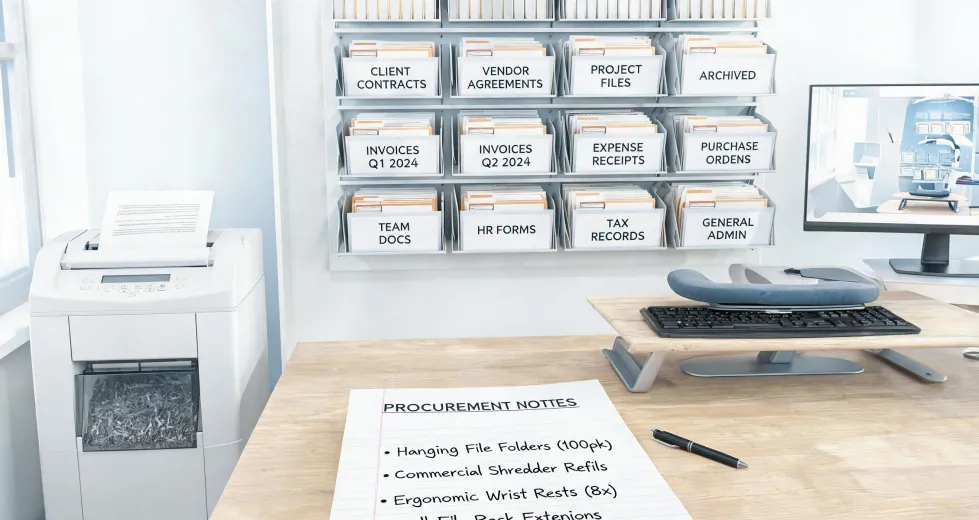
It's 4:47 p.m. on a Tuesday. The printer is not on the network. The Fellowes cross-cut shredder next to it is making a noise that sounds like gravel in a blender. And someone just remembered the layout for tomorrow's board folder is still on graph paper in a different room—because the PDF never made it to the shop.
In my role coordinating office equipment support for a B2B services company, I've triaged 200+ deadline-adjacent equipment calls in the last seven years. Same-day turnarounds, rush fees, and more than a few "please tell me you have a spare" conversations. I don't have hard data on industry-wide equipment failure rates, but my sense from those calls is this: most office equipment emergencies are not equipment failures. They're deferred maintenance and invisible configuration details.
The Surface Problem: A Jammed Shredder and a Missing Printer
Most emergency calls arrive with simple symptoms. "The shredder is jammed." "The printer disappeared." Both are true, and both are misleading.
Why does the printer always break at 4:47? It doesn't. It lost its network lease at 3:00, but no one needed it until 4:47. The shredder didn't suddenly get weak. It ran for months without oil, and paper dust finally caught up with the cutter.
A search for "how to oil fellowes paper shredder" is one of the most common support queries we track. People know the phrase. They just don't know the interval for their model, so the maintenance gets pushed until the machine forces the issue.
The Deeper Cause: We Treat Office Equipment Like Refrigerators
Here's the misconception: office equipment should be set-and-forget. Plug it in, walk away, replace it in ten years.
That thinking comes from an era when machines had fewer moving parts and fewer network dependencies. A refrigerator doesn't need an IP reservation. A printer does. A cross-cut shredder has a cutting cylinder that needs lubrication. A strip-cut shredder in a low-volume office might go years without attention—but a commercial Fellowes unit in a busy office isn't a refrigerator.
People think the printer is old and unreliable. Actually, the machine is usually fine. The IP address changed because no one reserved a DHCP lease. The printer isn't "bad"; it's invisible. The problem is the configuration, not the hardware.
The Cost of Ignoring the Boring Things
The cost shows up in rush fees and client meetings.
In March 2024, a client called on a Thursday at 4:00 p.m. They needed twelve customized board covers in hand before the Friday morning meeting. The normal turnaround from their usual shop was three days. We found another vendor who could produce them in eight hours, with a $300 rush fee on top of the $900 base cost. The alternative was walking into an investor meeting with a spiral notebook.
What had gone wrong? A missing font. The original CAD file used a custom typeface, and when the PDF was flattened, someone fixed it by hand instead of finding the right file. Not a dramatic failure. Just a missing font and a deadline.
When I'm triaging a rush order, I ask three questions: How many hours are left. Can the work happen in that time. What is the worst case if it can't. Those same questions apply to a shredder jam and a printer that won't connect.
Why the Odd Little Tools Still Matter
I keep graph paper in my bag. I also keep a crcl calculator bookmarked on my phone. Yes, the creatinine clearance one. In a shredder maintenance article, it looks out of place. But both tools solve the same problem: they give you a reliable answer even when the network is down.
A crcl calculator takes maybe thirty seconds to use. It doesn't need a login, a VPN, or a firmware update. If a coworker in a clinic calls you because they need a creatinine clearance estimate for a dosing decision, you can get that number while IT still hasn't found the print queue. But you can't send them the PDF—and they can't print it themselves—until someone fixes the printer's network connection.
The "graph paper is obsolete" idea comes from the same overconfident era that predicted paperless offices. The paperless office didn't happen. What happened is that we stopped drawing to scale and started assuming the network will always carry a sketch. When the network drops, a grid and a pencil beat a frozen screen.
What Actually Helps: Short, Boring, Specific Fixes
Before the next 4:47 p.m., set the boring fixes in place.
If you're searching "how to oil fellowes paper shredder"
Start with the Fellowes website. It has model-specific support PDFs. As of January 2025, the support section is the fastest way to confirm the oil type and procedure for your exact unit. Verify your model before buying any oil.
- Use a non-aerosol shredder oil. Do not use WD-40 or cooking oil.
- Follow your model's instructions—the standard method is a ribbon of oil across a sheet of paper, then shred it.
- Add a recurring reminder. A cross-cut shredder in a busy office generally needs oil every thirty minutes of shredding.
If you're searching "how to find ip address of printer"
This is a documentation problem, not a hardware problem.
- Print a configuration page from the printer's control panel. It will list the current IP address.
- Or check your router's DHCP client table—the printer's hostname should show up.
- Once you have the address, reserve it in the router so it doesn't change. Then write the IP on a label near the printer.
For the graph paper and crcl calculator: keep the graph paper in a drawer and save the crcl calculator link in a notes app. They're backup tools, not nostalgia. The point is to have a plan before the network disappears.
I'm not going to pretend oiling a shredder will fix every office equipment failure. If the cutting head is damaged or the motor smells burnt, that's a repair job for a local specialist. The vendor who says "this isn't our lane—here's who does it better" earns my trust more than the generalist who says "sure, I can handle it" and then can't find the part.
Your equipment isn't plotting against you. It's asking for the same attention you give your calendar. A little oil, an IP address that stays put, and a grid you can draw on without a login will solve more emergencies than a big-budget IT project.

Leave a practical note