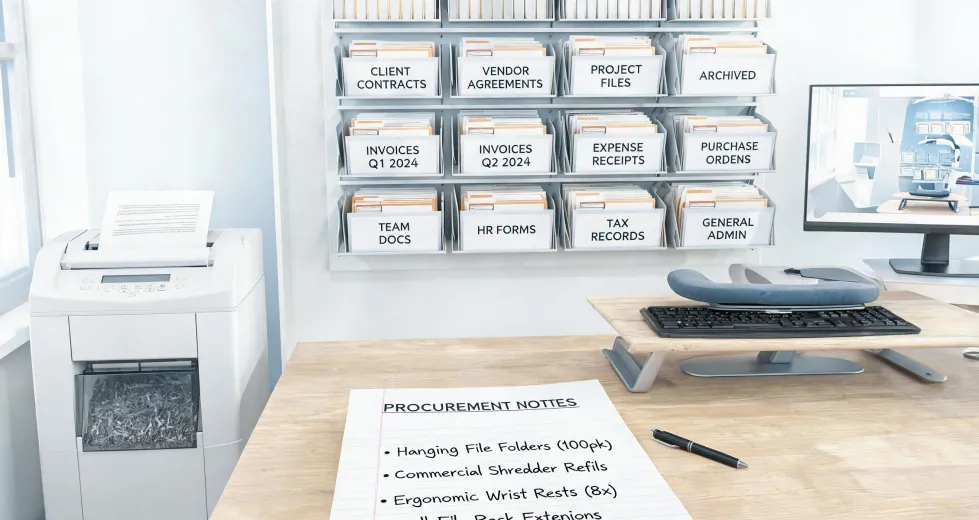
Look, if you manage an office, you've probably been there. The shredder is jammed. The printer is spitting out blank pages, again. You are staring at a piece of equipment that costs as much to fix as it does to replace, and you just need it to work. I'm an office administrator for a 150-person company. I handle all the equipment ordering, and after six years, I've learned there's no single answer to whether you fix it, replace it, or just keep kicking it.
The reality is that the right choice depends on three things: the equipment's age, the cost of downtime, and the nature of the failure. Here's the framework I use now, after making plenty of expensive mistakes.
Scenario A: The 'Almost New' Machine That Won't Cooperate
This is the most frustrating scenario. You bought a fellowes paper shredder or a new printer six months ago. It worked perfectly. Now, it's acting up. Your first instinct is to call the manufacturer for a warranty claim, and you should. But I've learned that manufacturers define 'working' differently than we do.
The Fellowes Shredder That Won't Run
My team had a fellowes cross cut paper shredder. It was about eight months old. It just stopped. The light was on, but it wouldn't cut. I assumed a mechanical failure. I spent an hour on hold with support. The technician asked, 'Did you check the oil light?' I hadn't. I didn't even know it had an oil light. A bottle of fellowes shredder oil cost $12. The machine was fine.
The mistake was assuming complexity where there was simplicity. Before you call for a replacement, check the basics: is it jammed? Is the basket full? Does it need lubricant? My rule now is: if the machine is under a year old and the problem is intermittent, it's almost always an operational issue, not a failure.
When to Actually Replace It
If you've done the basics and the machine still won't run, and it's within warranty, insist on a replacement unit. Do not accept a 'repair.' In my experience, factory repairs on low-cost shredders (<$300) are rarely worth it. The labor and shipping cost more than a new unit. But if it is a high-cost commercial fellowes paper shredder ($1000+), a repair is the better financial play.
Scenario B: The Misunderstood Failure
Some failures aren't really failures. They are misuse. When a user says 'my printer is printing blank pages,' the problem is rarely the printer itself. It's usually the driver, the ink, or the paper. I know this now because I made the mistake of ordering a replacement printer before checking the first one.
Here's the thing: blank pages from an inkjet almost always means clogged printheads. From a laser, it's usually a depleted toner cartridge that the printer doesn't detect. I now have a standard troubleshooting script. I run a nozzle check. I check the ink levels. It saves us from ordering a $400 replacement for a $40 problem.
The Percent Error Calculator Problem
A different kind of 'failure' is when your percent error calculator or software tool is off. I once wasted a week blaming a dtf printer for color shifts. I was running calibration tests, spending hours. It turned out my supplier had changed the ink formulation without telling me. The printer was fine. My input was wrong. Now, I always verify the supply chain before I blame the machine.
The lesson? Don't trust the 'obvious' problem. If a machine isn't working, ask: 'Did something change upstream?' That saved me a lot of time with our dtf printer when the transfers started failing.
Scenario C: The End-of-Life Decision
This is the big one. You have a fellowes paper shredder or a printer that's been a faithful workhorse for four or five years. It's running, but it's slow. It jams more. It makes that 'I am dying' sound. Should you fix it or replace it?
My rule of thumb is simple: if the repair is more than 50% of the replacement cost, replace it. This isn't just about money. It's about downtime and reliability. A repaired machine is never as good as a new one. The bearings are worn. The plastic is fatigued. You'll be fixing it again in six months.
But here's a nuance I learned the hard way. The replacement cost isn't just the price of the machine. It's the cost of delivery, setup, and employee training. When we replaced our old shredder with a new fellowes cross cut paper shredder, the unit cost was $250. But I spent another $100 on disposal of the old one and shipping. Plus, the staff had to learn the new safety features. The real cost was closer to $400.
The Brand Loyalty Trap
Brand loyalty is a thing. We were a fellowes office, almost exclusively. Their products served us well. But when I had to replace our laminator, I looked at other brands. The fellowes model was $280. A comparable competitor was $180. The specs were nearly identical. I bought the competitor. It has worked fine for two years. The lesson? Don't be afraid to step away from the brand name if the repair cost is high. Your CFO will thank you.
How to Decide: A Simple Framework
I don't use a complex matrix. I ask three questions:
- What is the age of the equipment? Under 1 year? Troubleshoot and warranty. 1-3 years? Repair if it's a single, known fix. Over 3 years? Seriously consider replacement.
- What is the cost of the failure? If the shredder is down for a day, does it matter? For high-use equipment (a shared printer or a heavy-duty shredder), downtime is expensive. For a department-adjacent machine, you can wait.
- Is the problem repairable? A motor burnout is fixable. A cracked plastic gearbox is not. A failed circuit board on a cheap printer is a write-off.
For example, our main printer is an absolute beast. It is five years old. It had a paper feed issue. I found a YouTube video showing a $15 part. I replaced it myself. That was a repair. But last month, our fellowes paper shredder not working was a different story. It was six years old, and the motor was seized. I didn't even bother with a quote. I ordered a new one. The old one went to e-waste.
The final piece of advice? Don't store spare equipment 'just in case.' It's a waste of capital. Instead, have a faster purchasing approval process. If a machine dies, I can get a new one delivered in 2 days. That's cheaper than sitting on a $600 backup printer for two years. This system isn't about avoiding failures. It's about making the right call when they happen.

Leave a practical note