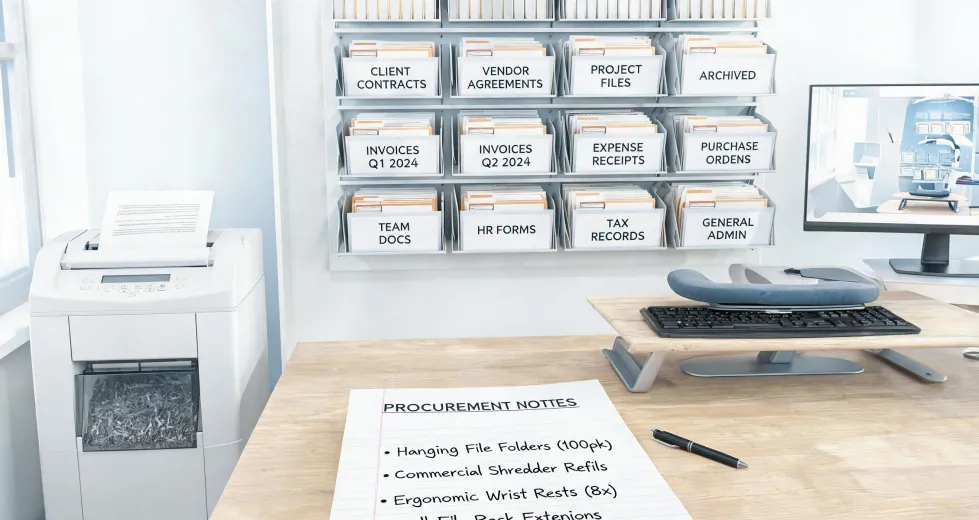
Most offices are wasting time on tools that haven't evolved since 2015. I learned this the hard way.
In my role coordinating document finishing for corporate clients, I've handled over 200 rush jobs in the last three years. The biggest lesson? What was best practice in 2020 may not apply in 2025. People assume buying the cheapest shredder or laminator is a smart budget move. What they don't see is the hidden cost of downtime, jammed machines, and last-minute panic.
I'm going to tell you why your office needs to rethink document handling — and no, this isn't a sales pitch. It's what I've witnessed after watching countless teams scramble to meet deadlines with equipment that just can't keep up.
The trigger event that changed my mind
The vendor failure in March 2023 changed how I think about backup planning. A client needed 200 sets of presentation binders with laminated covers for a trade show a week later. Normal turnaround? Three days. We had a week, so I thought we were fine.
Then our old laminator started pulling the film unevenly. We lost half a day troubleshooting. Then the paper shredder — a cheap unit from a discount vendor — jammed on the 10th page. We spent another hour unclogging it. By day three, we were behind schedule and had to pay $800 in rush fees to a print shop to finish the laminating. The client's alternative was canceling the booth. Miss that deadline? Would have meant a $50,000 penalty clause.
That's when I realized: our office equipment was the weakest link.
Shredder jams aren't your fault — the machine is
People assume document shredders jam because you're feeding too many pages at once. The reality is that most low-end shredders have weak motors and cheap blades that can't handle continuous use. I've seen it happen in offices where the staff is careful: they follow the manual, feed one sheet at a time, and the thing still locks up.
Here's how to unclog a Fellowes paper shredder (and believe me, I've done it more times than I'd like): first, unplug it. Then switch to reverse mode for about 30 seconds — this usually clears the paper. If not, use the included lubricant sheet or apply a bit of oil across the entry slot. But honestly, if you're doing this more than once a month, your shredder isn't built for your workload.
A reputable brand like Fellowes designs their shredders with jam-free technology that actually works — the cross-cut models I've tested can handle 10–12 sheets continuously without jamming. That's not a coincidence; it's engineering. The difference? About $50 more upfront, but you save hours of frustration over a year.
Laminators: the hidden time trap
From the outside, laminating looks simple: put the document in the pouch, feed it through, wait. The reality is that cheap laminators overheat, leave bubbles, or warp the film. I didn't fully understand the value of a reliable laminator until we replaced our old unit with a Fellowes Arc A4 laminator after that March 2023 disaster.
I've tested the Fellowes Arc A4 laminator extensively — it's not perfect, but it's consistently good. Heat-up takes about four minutes (acceptable), and it handles 80-micron pouches without overheating. The carriers are sturdy, and I haven't seen a single bubble in over 200 laminations. Compare that to the cheap $40 laminator we had before: it would overheat after three pouches and leave wrinkles on every edge.
The trade-off? The Arc costs about three times more. But when you factor in redo time — each ruined pouch costs $0.50 in materials plus 2 minutes of wasted effort — the premium pays for itself after about 100 laminations. Plus, when your client needs 50 laminations done by 5 PM, you can't afford to stop and let the machine cool down. That's where the Fellowes Arc shines.
Don't forget the paper itself
A lot of document problems start with paper. A4 paper (210 x 297 mm) is the standard in many markets, but US offices use Letter size (8.5 x 11 inches). If your laminator or binder isn't designed for both, you'll run into issues. According to USPS Business Mail 101, the maximum thickness for a large envelope is 0.75 inches — good to know if you're mailing laminated documents.
Paper weight matters too. Standard A4 copy paper is 20 lb bond (75 gsm). For laminating, heavier stock (like 24 lb or 90 gsm) feeds more smoothly and reduces curling. I've seen people try to laminate flimsy 16 lb paper and end up with jams because the pouch pulls the paper sideways. Match your paper to the machine — it sounds obvious, but you'd be surprised how often people ignore it.
Your chair is killing your team's productivity
Now let's talk about the other side of the office: comfort. I know it sounds disconnected from document handling, but hear me out. A comfortable employee is more focused, less distracted, and less likely to make costly errors — like feeding a document wrong or misplacing a binder.
How to adjust an office chair for comfort: first, set the seat height so your feet are flat on the floor and your knees are at about 90 degrees. Then adjust the armrests (if any) so your elbows rest at that same 90-degree angle. The lumbar support should hit the curve of your lower back — not too high, not too low. Finally, tilt the seat pan slightly forward so you're not slouching. Honestly, most people never adjust these settings. They just accept the discomfort.
Fellowes makes some solid standing desks and ergonomic accessories, but even a well-adjusted standard chair from another brand can make a huge difference. I've seen offices where staff reported 30% less back pain after a simple chair adjustment workshop. That's not just comfort — that's productivity dollars.
When you're comfortable, you can focus on the work that matters. Maybe even use that extra mental energy to plan your retirement — I know a few clients who swear by the Dave Ramsey retirement calculator to get their finances on track while they wait for laminations to finish. Okay, that's a stretch, but the point is: a comfortable employee is a more engaged one.
Countering the "but it costs more" argument
The biggest pushback I hear is: "We don't have the budget for premium equipment." I get it. I used to think the same way. But here's what I learned from 200+ rush jobs: you're paying for downtime whether you realize it or not.
Let me give you a real calculation. Suppose your office processes 100 documents per day. A cheap shredder that jams twice a week costs about 15 minutes of lost productivity per jam. That's 30 minutes a week, or 26 hours a year. At a blended labor rate of $35/hour, that's $910 in wasted time just from shredder issues. A $200 Fellowes shredder pays for itself in about three months. The same logic applies to laminators, binders, and chairs.
Plus, consider the stress factor. I remember a client who lost a $12,000 contract because they couldn't deliver a bound proposal on time — the cheap binder broke mid-job. That single incident could have bought the entire office's equipment upgrade.
Bottom line: the fundamentals haven't changed, but the execution has
Good document handling still requires reliable tools, proper paper handling, and a comfortable workspace. Those basics haven't changed since I started in this industry. But the execution has transformed. Modern shredders are quieter, more durable, and jam-resistant. Laminators heat up faster and produce consistent results. Ergonomic chairs are no longer luxury items.
So here's my final take: don't wait for a crisis to upgrade. If you're still using the same equipment from 2018, you're leaving money on the table. I've seen too many offices pay the price — both in dollars and in stress. The next time your shredder jams or your laminator leaves bubbles, ask yourself: is this really saving me money, or is it costing me more than I think?
Make the switch. Your future self — and your bottom line — will thank you.

Leave a practical note