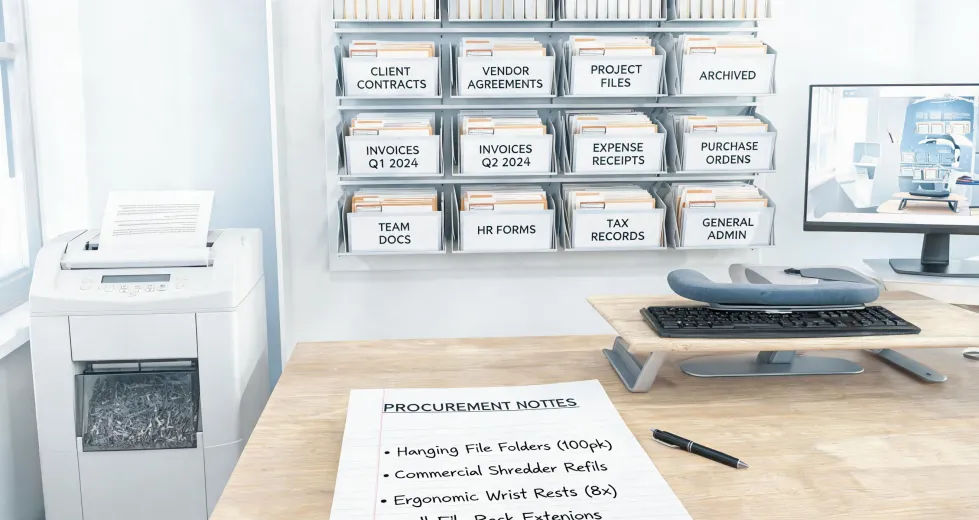
In October 2024, I sat at my desk staring at a fourteen-page quote from a local event supplier. One signature and I'd cover our entire Q4 employee appreciation budget in a single purchase order. Fourteen thousand dollars. Four separate categories of stuff.
Six weeks from the event. About 900 employees on our payroll. And a list of procurement requests that had quietly grown from "pick up some pens" into something closer to a scavenger hunt.
Let me back up.
How I Ended Up Buying This Many Things
Our company has a small tradition: employees who hit five years get a nice pen. Not the plastic promotional stuff. A pen worth keeping. In past years that's meant cross pens, engraved, handed out at the anniversary table. People actually keep them.
This year, three other requests landed on my desk within the same week.
HR wanted gift bag items including a rare beauty highlighter for the women's wellness gift pack—don't ask me how a pen distributor's budget got mixed up with a cosmetics order. Our clinical team needed what they called a "reference tool" printed on laminated cards for the health screening station—specifically a creatinine clearance calculator, because they refuse to trust the online ones. And our art team, who was running a kids' station at the family open day, asked me to figure out how to erase colored pencil without smudging the design underneath—apparently that's a whole thing.
Four different categories. My instinct, having consolidated twenty vendors down to eight over the past two years, was to consolidate again.
So when a colleague recommended a one-stop event supplier who claimed to handle "everything from pens to party favors," I sent them the full spec sheet.
The quote came back in four days. Clean. Itemized. $14,000 all-in.
I almost signed it on the spot.
Where the Quote Started Falling Apart
I've been burned before by clean quotes. In 2023, I almost approved a $4,200 "all-inclusive" annual contract that came back with $450 in hidden packaging and fulfillment fees—I caught it because I read line 47 of 62. That habit saved me again this time.
I broke the quote into components and started checking.
Component one: the standard cross pens. The vendor quoted $42 per pen for "discount cross pens" engraved with our logo. I compare-priced against two authorized distributors and one Cross direct account. The authorized rate for the same model was $58 per pen, engraved. The one-stop shop's $42 was too good.
Turned out those weren't authorized. They were gray-market clearance, sourced from a liquidator. Cross's lifetime warranty—the actual, legitimate warranty that makes their pens worth buying—wouldn't have applied to our purchase. That's the entire value proposition, gone, for a $16-per-unit "savings" I never asked for. I respect the brand for one reason: you buy once, and it holds. Silently stripping the warranty to save a line item was the opposite of what my CFO wanted.
Component two: the vintage Cross pen sets. Our operations director is retiring in March, and our VP wanted to give him something special—specifically some cross pens vintage, from the 1970s–1990s production runs, which apparently hold up better than newer ones for some collectors. The one-stop vendor said "no problem." I asked them how they'd source authentic 1980s stock. The answer was, "we'll find something online."
That's not sourcing. That's gambling.
Component three: the rare beauty highlighter. I called to confirm the exact shade and SKU. The vendor's response: "We can't get that, but we can substitute a different brand's highlighter." Which—no. HR had a specific shade they wanted for a reason. Substituting deflates the whole request.
Component four: the creatinine clearance calculator. When I told them the clinical team needed this on laminated reference cards for a screening station, the vendor asked if a "spreadsheet template" would work.
For a calculation. At a clinical event. This is the moment I started questioning my life choices.
Component five: the colored pencil erasing problem. The art team's request was specific—they needed actual art erasers that work on colored pencil without lifting the wax coating and tearing the paper fibers underneath. The vendor said they'd include "some erasers." Standard pink school erasers. Which technically remove the colored pencil. And technically ruin the surface.
Five requests. Five partially wrong answers. The quote was organized, formatted beautifully, and substantively 60% of what we needed and 0% of what we specifically asked for.
The Vendor Who Said No
Here's the thing about that quote—the one-stop shop didn't do anything dishonest. They didn't lie. They hedged. Every single line item was "approximately" or "comparable to" or "or equivalent."
After two days of back-and-forth, I called the owner of the one-stop shop and asked him directly: what are you actually good at?
His answer: "Honestly? Big decor installations and event rentals. Pens, cosmetics, medical reference materials—those are things we quote because clients ask, not because we're the best source."
I asked him to send me a revised quote for the actual deliverable he could do well—the event setup and rentals—and I moved the rest elsewhere.
That conversation, weirdly, is what I remember most from this whole procurement cycle. He didn't lose my business by admitting his limits. He earned a repeat order.
What I Did Instead—and Where It Landed
I broke the $14,000 into four smaller orders.
Pens (authorized Cross): I went through a Cross-authorized distributor with a proper account. Cost $11,200 for the anniversary pens (95 units plus engraving). More per unit than the gray market. But the warranty intact means fewer replacement headaches and—more importantly—a gift that doesn't quietly fail in someone's desk drawer six months later.
Vintage Cross pens: I found a specialist collector through a pen forum who sourced two authenticated late-1970s sets at $410 each, with provenance documentation. The one-stop shop would have had to buy blind. Total time investment: about ninety minutes of email. Worth it.
Rare beauty highlighter: Ordered direct. $34 per unit, ten units. Shipping was flat-rate. Zero drama.
Clinician reference cards: Our clinical team drafted the content; a local print shop printed and laminated forty cards for $180. The creatinine clearance calculator itself—the formula—was already internally approved, so we just needed to source the physical output. Two hours, done.
Art erasers for colored pencil: Ordered from an art supply specialist. The specific tack erasers that lift wax-based pigment without damaging the paper underneath. $22 for a box of twelve. The art team was unreasonably happy about this. Apparently school-issue pink erasers have been their quiet nemesis for years.
Final spend: $13,684. Roughly a 2.3% under the original quote—not because I negotiated hard, but because I stopped paying a generalist premium for specialist work.
The Lesson I'm Still Chewing On
Here's the part I have mixed feelings about. I still want fewer vendors. The consolidation instinct is right—fewer invoices, fewer contacts, fewer things that can go wrong. But that instinct nearly led me to $14,000 of things that were approximately right and specifically wrong.
The vendor who told me what they couldn't do saved me from that. So the rule I've written into our procurement policy this quarter: on any purchase over $5,000, we require at least one conversation where we directly ask the vendor what they don't do well. The answer tells me more about fit than any brochure.
And yes—if you've ever tried to erase colored pencil off a textured watercolor sheet, you know the panic of watching a smear appear where a kid's drawing used to be. If you haven't, trust me on this one: buy the right eraser before the event, not after.
As for the Cross pens—the retirement sets are already in a drawer in my office. I'm not giving those to a generalist. Simple.

Leave a practical note