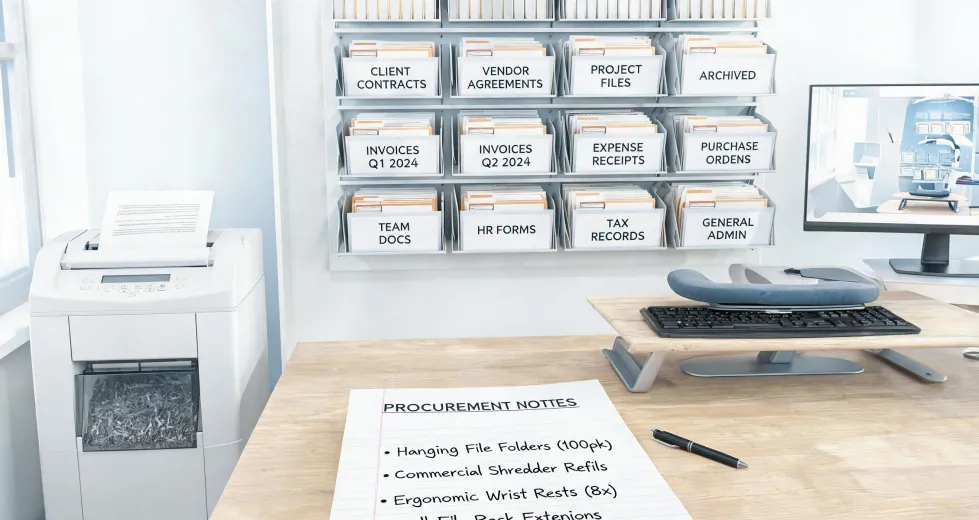
Let me start with a confession: I have bought the wrong office equipment more times than I want to count. A standing desk that didn't fit my workflow. A shredder that jammed within the first week. A box of binders that fell apart during a client presentation. I've been handling office orders for seven years. In my first year (2018), I made the classic mistake of choosing by price alone. Since then, I've documented at least 11 significant mistakes, totaling roughly $2,300 in wasted budget. Now I maintain our team's checklist. This is that checklist, in article form.
There is no single right answer for a Fellowes standing desk or a Fellowes cross cut paper shredder. The right question is: where does paper actually land in your office? Who handles it? What happens before a client visits? The answer changes everything.
The three office scenarios I now plan for
I don't categorize offices by company size anymore. I categorize by workflow. Three scenarios cover most situations, and each one needs a different setup.
Scenario 1: You are the solo operator
If you work alone, your equipment is your assistant. You need a desk organizer more than you need a standing desk. Wait—that sounds backwards, but I mean it. A standing desk does nothing for you if the surface is buried under loose papers. The first time I bought a standing desk, I didn't have a proper place for mail, sticky notes, or the file I needed for tomorrow. So the desk stayed in sitting mode because the clutter made it impossible to change posture.
That's why I'd set up a Fellowes standing desk only after the desk organizer is in place. What I mean is: clear surface first, height adjust later. When the desk is clear, a sit-stand desk actually gets used. My current setup is a Fellowes standing desk, a simple desk organizer for incoming mail and scribbled notes, and a Fellowes cross cut paper shredder on a side table.
I know a cross-cut shredder sounds like overkill for one person. The 'shredders are all the same' thinking comes from an era when offices had a single machine near the copy room. Today, paper lands in your office, not in the copy room. If you don't shred near where the paper lands, you'll recycle something you shouldn't.
A Fellowes cross cut paper shredder turns documents into small confetti, not long strips. Does that matter? Yes. Strip-cut strips can be reassembled. Cross-cut pieces can't. For a solo business, cross-cut is the sweet spot. Micro-cut is more secure, but it fills a bin twice as fast. I use cross-cut because I'd rather change the bin than re-shred a 40-page report.
Scenario 2: You are client-facing
If customers visit your office, your equipment is your branding. A dirty whiteboard says 'we don't pay attention to details.' A binder that falls apart says the same thing.
I learned this the hard way. In March 2023, I prepared a 60-page proposal for a potential client. I used cheap binders to save $2.50 per copy. On a 40-copy order, that seemed smart. Then the first person who opened one cracked the spine. They didn't say anything. They just slid the pages into a folder. We didn't get the account. I can't prove that binder lost the deal, but I can tell you it didn't help.
The $4 difference between a cheap binder and a solid one is nothing compared with the message it sends. When a client's first physical touch of your company is a binder that breaks, they assume your work will break too. That's not about luxury. It's about not letting the supporting materials undermine the actual work.
The binder incident in March 2023 changed how I think about the link between office supplies and brand. Now every purchase goes through the same test: will this make the client's first impression better or worse?
In a client-facing space, a Fellowes standing desk is worth the money for a different reason: it tells visitors that this office cares about how people work. It's a visible sign that you invest in your team. Do you need one at every desk? No. That's where people overspend. You need one in the conference room or in an office where someone actually switches between sitting and standing. Put a desk organizer on the front desk, too. It says 'we have a system.' If you've ever seen a pile of sticky notes on a client's front desk, you know what the opposite looks like.
Scenario 3: High-volume paper zone
Some offices are paper-processing machines. Invoices, permits, client intake forms, receipts. If that's you, get a heavy-duty Fellowes cross cut paper shredder with a bigger bin. The mistake I made was buying a personal shredder for a shared workload. It overheats, jams, and people start ignoring it.
At our last office, I bought a personal shredder because it was on sale. It jammed on day four. Actually, it jammed on the first day, and I cleared it, and then it jammed on day four. We spent $80 on a machine that couldn't handle 15 pages a day. Then we replaced it with a Fellowes cross cut paper shredder designed for heavier use. I should mention: we also changed when we shred. The machine goes on at the end of the day, not five times an hour.
If you handle customer information—names, addresses, account numbers—the FTC's Safeguards Rule (ftc.gov) may apply to you. It requires reasonable safeguards for customer information, and secure disposal of paper records is part of that. A cross-cut shredder isn't a luxury in those offices. It's a compliance staple.
How to tell which scenario you are in
Still not sure? Answer three questions.
- Where do you physically open mail and handle documents? If it's your desk, you're scenario one. If it's a central area, scenario three.
- Do clients or suppliers visit your workspace? If yes, you're scenario two at least part of the time.
- How many documents leave your office in a week? More than one ream? Don't buy a personal shredder.
Oh, and the whiteboard.
And yes: how to clean whiteboard surfaces
I promised this. Here's how to clean whiteboard surfaces without wrecking them.
Use a dedicated whiteboard cleaner or a damp microfiber cloth with isopropyl alcohol. Water alone won't remove dry-erase residue after it's been on the board for a few days. I know because I tried it on a board that had notes from six meetings. The ghost of 'next Q' stayed on the wall.
Regular glass cleaner? No. Wait—some people use it successfully on new boards. But if your whiteboard is older, ammonia-based cleaners can strip the surface coating. Stick with alcohol or a purpose-made spray.
Here's the counterintuitive part: don't clean your whiteboard every day. Clean it when the residue is fresh, and it stays cleaner longer. If you let marker sit for a week, you're scrubbing the board and wearing it out. A quick weekly wipe with a microfiber cloth is enough.
The budget rule that actually works
None of this is about buying the most expensive thing. It's about matching the equipment to the work. A clean desk organizer, a reliable Fellowes cross cut paper shredder, a standing desk you actually use, a binder that doesn't break, and a whiteboard you can read—those are the details that tell clients you're paying attention.
The question isn't 'which product is best?' It's 'which product will actually get used in your office?' Get that right, and the rest sorts itself out. That's it.

Leave a practical note