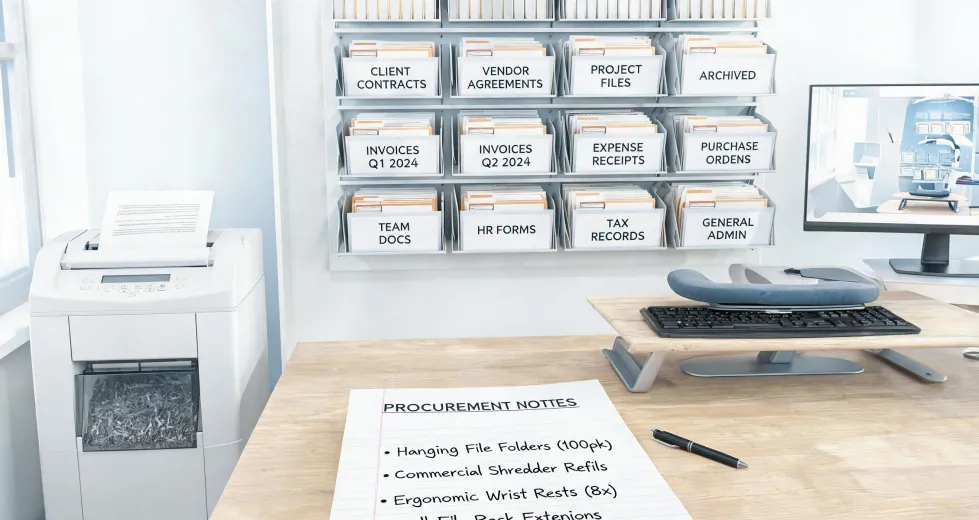
There's no universal answer for which office equipment is 'right.' It depends on your team size, your workflows, and how much risk you can tolerate. I learned this the hard way over eight years of ordering and maintaining office gear. In 2017, I approved a custom 3 ring binder order with the wrong spine width. 250 binders, around $1,050, straight to the bin. That mistake is why I started documenting equipment failures, setup errors, and the occasional finance miscalculation. Here are the scenarios that keep showing up, and what I'd do differently.
Shredder Scenarios: Fellowes Paper Shredder 79ci and the Jam Trap
The current shredder in our office is a Fellowes paper shredder 79ci. Twenty-sheet capacity, cross-cut, good for a small team. It's not the biggest model Fellowes makes, and that's the point. The first shredder I bought for our office was a bigger commercial unit, and it jammed constantly. From the outside, a shredder jam looks like a paper quality problem. The reality? It was a feeding problem. My team saw a larger capacity and assumed they could push it. So the larger machine became a trap.
I went back and forth between the heavy-duty model and the 79ci for two weeks. The heavy-duty one offered more capacity and a larger waste bin. The 79ci was quieter, cheaper, and took less space. On paper, the heavy-duty made sense. But my gut said my team would feed it even more aggressively. I chose the 79ci because it forces a little patience at the feed slot.
If you're Googling 'fellowes paper shredder jam' because something just jammed, don't panic. Here's the workflow that works for me: power down, unplug, reverse the motor, then slowly pull the jammed paper upward. Not sideways. Upward. That's it. My first jam took me an hour because I pulled sideways and shredded the paper into smaller strips. The 79ci has a reverse switch on the front, and using it before pulling usually clears the jam.
Which shredder scenario are you in?
- Small office, fewer than 10 people: The Fellowes paper shredder 79ci is probably enough. If you're replacing an old shredder, don't upsize just because a bigger model is on sale.
- Mailroom or high-volume team: Look for a commercial series with a wider throat and continuous-duty motor. The 79ci isn't designed for hours of shredding.
- Jam recovery: Don't pull sideways. Use reverse, then pull upward.
One more thing about jam-resistant claims. Per FTC guidelines (ftc.gov), advertising claims need to be truthful and substantiated. So 'jam-resistant' doesn't mean 'jam-proof.' My 79ci still jams, but only when someone overfeeds it. That's on us, not the machine.
Three Ring Binders: The Mistake That Cost Me $1,050
The binder mistake I keep replaying was, on the surface, a simple order. I needed custom 3 ring binders for a proposal kit. I measured the cover stock, the page sizes, the thickness of the inserts. Then I chose a 1-inch ring. When the binders arrived, they looked great. But open one up, and the pages were too much for the rings. The back page slid out. We had to reorder with 1.5-inch rings.
Here's what I learned: page count determines ring size, not cover look. For standard 20 lb paper, a 1-inch ring holds about 150 pages. A 1.5-inch ring holds around 250. If you're not sure, test with the actual paper before ordering hundreds of units. I didn't test. I guessed. A lesson learned the hard way.
Binder scenarios to consider
- External proposals: If the binder is going to a client, choose a heavy-duty ring mechanism. A high-end cover doesn't matter if the rings won't close evenly.
- Internal documentation: Save money on the cover, not on the rings. Flippy rings are the first thing people break.
- Mailing binders: Check USPS limits first. According to USPS Business Mail 101 (usps.com/businessmail101), a large envelope can't exceed 0.75 inches in thickness. A 1-inch binder with 150 pages is likely over that. Plan for a package rate, or use a different format.
The Dividend Calculator Habit (And Why It Works)
I know a dividend calculator sounds out of place in an article about shredders and binders. Stay with me. Before I bought the Fellowes paper shredder 79ci, I had to justify replacing the big commercial shredder that kept jamming. So I ran a quick dividend calculator scenario: if I invested the $400 difference instead of spending it, what would it be worth in five years? At a 6% annual return, not huge. But then I did the other side: the jammed shredder was costing about 20 minutes per week. At $50/hour for my team's time, that's $870 per year in wasted time. The calculator didn't make the decision for me. It made the choice obvious.
I want to say the dividend calculator was from a brokerage site, but don't quote me on that. The exact tool doesn't matter. The framework is what matters: consider the opportunity cost of the money you're about to spend, and compare it to the cost of not acting.
Replace vs. repair: a simple check
- How often do you troubleshoot the equipment? Once a month is annoying. Once a week is a reason to replace.
- What is the downtime cost? Be honest. If it's twenty minutes a week, that adds up fast.
- What is the cost of waiting? This is where the dividend calculator helps. It's not about picking the perfect return. It's about making the tradeoff visible.
I'm not a financial advisor, and I don't pretend to be. For tax or investment decisions, talk to someone who actually knows what they're doing. My point is narrower: don't buy equipment just because it's on sale, and don't postpone a needed replacement just because the upfront price feels high. Run the numbers. Then make the call.
How to Connect an Epson Printer to a Computer: Three Scenarios
The search term 'how to connect epson printer to computer' gets a lot of generic advice. The truth is, the best method depends on your setup. I've set up three Epson printers in different offices and used every connection type. Here are the scenarios that matter.
Scenario 1: One computer, one printer
Use a USB cable. That's it. The old assumption that 'wireless is always more modern' comes from an era when USB connections were slow. Today, a direct USB connection is fast and easy to troubleshoot. If the printer is right next to your computer, plug it in and don't overthink it.
Scenario 2: A shared office on Wi-Fi
Use Wi-Fi, but connect the printer and the computers to the same 2.4 GHz network. I once spent a full afternoon on a support chat because the printer was connected to the guest network while the computers were on the main one. Restart the printer and the computer before you try anything else. That fixes more Epson connection problems than any driver update I've found.
Scenario 3: A larger team or a server room
If you have a dedicated server or more than a handful of users, use Ethernet if your Epson model has a port. It's more reliable than Wi-Fi, and it avoids the 'the printer keeps dropping' complaint. The setup steps are the same: download the driver from Epson's site, run the installer, choose Ethernet or wired connection, and follow the prompts.
From the outside, a connection problem looks like a driver issue. The reality is usually network-related. The printer doesn't disappear because the driver is broken; it disappears because it's on a different network. Check that first.
Which Scenario Are You In?
If you're still not sure where to start, ask yourself three questions. First, is the problem a jam, a connection issue, or a sizing problem? That narrows it down. Second, how many people are affected? If it's one person, solve it for one person. If it's a whole office, solve it for the whole office. Third, how much is the delay costing you? That's where the dividend calculator mindset comes in.
No vendor can be the best at everything. In my experience, the ones who say 'that's not our strength' earn more trust than the ones who promise to handle everything. For shredders, binders, printers, and even financial calculations, the tools are less important than the judgment behind them. My judgment got better after a few expensive mistakes. I hope this helps you skip the expensive part.

Leave a practical note