I believe most companies are losing more money on "cheap" office equipment than they'd ever save by buying it. That's not a hot take—it's a conclusion I've arrived at after six years of managing procurement for a mid-sized firm, tracking every invoice, and building cost models that compare vendors down to the penny.
Let me establish my credentials: I'm a procurement manager at a 150-person professional services company. My office operations budget runs about $30,000 per year. Since 2019, I've negotiated with 40+ vendors and documented every order in our cost tracking system. I'm the person who says "let me check the spreadsheet" in meetings—and I actually mean it.
So when I say most companies are making a false-economy mistake with their office supplies, it's not an opinion I'm floating. It's a pattern I've watched unfold in my own purchasing data, over and over again.
The Desktop Copyholder That Started It All
It started, of all places, with a Fellowes Office Suites desktop copyholder. A $40 piece of plastic. I was skeptical.
(This was back in 2023, during our annual office refresh. The assistant team had been complaining about neck strain from reading paper documents flat on their desks.)
I ordered one copyholder for testing. It arrived, I handed it to the most vocal complainer, and I waited for the inevitable "it's fine, I guess" reaction. Instead, she came back a week later and asked if we could order them for the whole department. Then the adjacent department. Then a client noticed during a site visit and asked where we got them.
Nothing about the product was flashy. It held paper at eye level, it didn't wobble, and it clipped documents without bending the pages. It was simply... well-made. That small quality difference eliminated daily friction we had normalized for years.
I should add that this is when I started rethinking our entire procurement philosophy. If a piece of plastic could make that much difference, what else were we getting wrong?
File Organization Is a Productivity Investment, Not a Cost
Here's something vendors won't tell you: the cheapest option on the shelf is almost never the cheapest option for your business.
When I audited our 2022 spending, I found we were reordering basic file supplies every few weeks. Desks were buried under paper. Documents were going missing. And nobody had actually measured how much time the chaos was consuming.
So I did. Over a two-week period, I asked team members to log every time they searched for a document and how long it took. The results were embarrassing. We were burning about 10 minutes per person per day on document-related searching—roughly 40 hours per employee per year. Maybe 35, depending on the role. Either way: a full work week, gone.
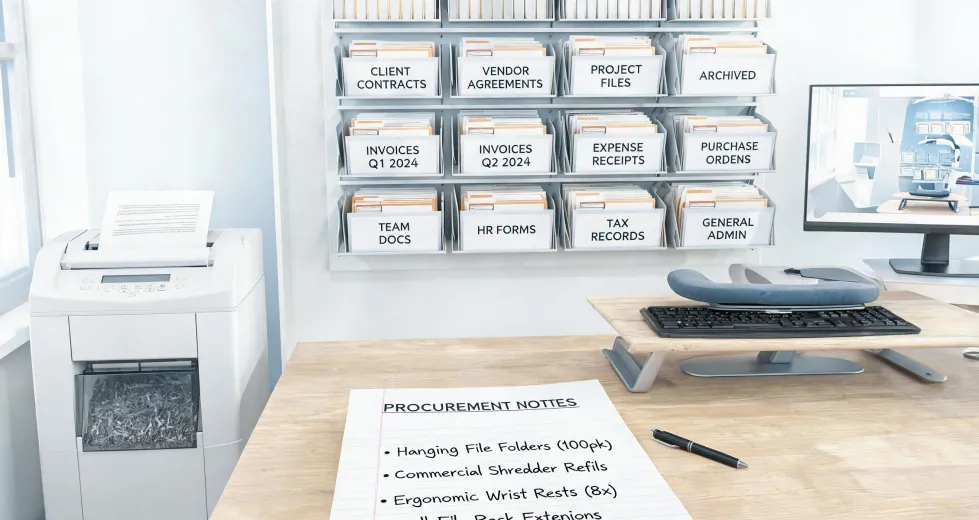
We invested in Fellowes metal file organizers—sturdy, stackable, well-labeled units that made it obvious where active files lived and where archived ones went. Within a month, reorder frequency dropped by about 30%. Maybe 25%—I'd have to pull the exact numbers from our inventory system to confirm. Regardless, the improvement was obvious.
The financial math was almost too easy. When files go missing, documents get re-sent. With USPS First-Class postage at $0.73 per ounce as of January 2025 (usps.com), every misrouted document carries a real cost—before you even factor in labor. The organizers paid for themselves in time savings within a month. I'd estimated break-even at two months, so I was pleasantly surprised.
When Your Printer Says "Offline" and Nobody Gets Paid
Now let's talk about our HP printer. This one stings a little, because it was entirely preventable.
Our main office printer, an HP model bought new in 2018, started dropping off the network around mid-2024. At first it was once a week. Then twice. Then daily. Employees took to googling "why does my HP printer say offline," finding forum threads from 2019, trying registry fixes, and restarting services. I watched a senior accountant spend 45 minutes on this. She eventually emailed the document to IT and asked them to print it. A single page. Because the printer was offline.
When I finally called our IT support, the diagnosis was humbling: the printer was old, its firmware was outdated, and we'd skipped maintenance because it "still worked." We'd saved maybe $200 per year by not servicing it, and we were burning that up in employee time every quarter.
I have mixed feelings about service contracts. On one hand, they feel like paying for insurance you hope you never need. On the other, our first year with a proper maintenance agreement cost exactly what one quarter of printer downtime had cost us in labor. The math was unambiguous.
We replaced the printer with a business-grade model and enrolled it in proactive maintenance. In the six months since, I can count the printer-related support tickets on one hand. Maybe one and a half hands. Either way, it's a dramatic drop from the weekly chaos we'd normalized.
Bringing Real Math Into Procurement
Somewhere around year three, I started treating office supply decisions like vendor negotiations—with formulas and data instead of habit and momentum.
I keep a rounding calculator open on my second monitor most days. It's faster for quick estimates than opening Excel, especially when I'm roughing out annual costs across multiple line items. A $12.99 item isn't $13 in my head; it's $156 per year if we order it monthly. Small numbers become big numbers fast.
The bigger shift came when I had to compare three vendors for our supply contract. Each had a different pricing structure: low unit price with delivery fees, a "free setup" offer with hidden training costs, and a flat-rate quote that looked expensive up front. I needed the break-even point across all three.
That's where a system of equations calculator earned its place in my workflow. Instead of spending a full day building a spreadsheet, I modeled the cost structures, ran the equations, and found the flat-rate vendor—the one that looked most expensive—was actually 17% cheaper over 12 months once all fees and error rates were factored in.
The lesson stuck: the quote is not the price, and the sticker price is not the total cost. (Should mention: we've since used that same calculator for budget forecasting and a departmental cost-allocation debate. It's a legitimately useful office tool.)
"But We Can't Afford Premium" — I've Heard It Before
Look, I know what some of you are thinking: not every company has the budget for premium equipment. I've sat in meetings where a five-dollar difference per item was a serious discussion. Budgets are real, and I'm not telling you to ignore them.
But there's a difference between being cheap and being cost-conscious. Being cost-conscious means asking: where does the spending actually create value?
My rule now: buy quality for the things that touch people daily—the tools employees use, the furniture clients see, the equipment that keeps the office running. Save money on the things that don't matter: pens, paper clips, sticky notes, generic supplies that nobody remembers.
To be fair, this rule took me years to learn. In the beginning, I went with the lowest quote on everything. That's how we ended up with a printer that caused weekly chaos and a filing system that wasted 40 hours per employee per year. The savings were an illusion—we were shifting costs from the purchase order to payroll, and the P&L didn't show it.
Quality Is Visible. Clients Notice.
Let me end with something that doesn't fit neatly into a spreadsheet.
When a client or vendor walks into your office, they form judgments within seconds. They see the cluttered desks, the flimsy copyholders, the printer being coaxed back online. They don't know how much money you saved on supplies—they just see friction. And friction reads as incompetence, even when it isn't.
I can't put a precise dollar figure on client perception. But I watched it change after our office refresh. The same team, working with proper tools, stopped apologizing for their equipment. That confidence difference was visible. And confidence is quietly persuasive in business conversations.
Per FTC guidelines (ftc.gov), I should note these are my personal observations from our specific context, not universal claims about any brand's products. But I'll add this: when I run the numbers, quality isn't an expense. It's an investment with measurable payback in time saved, errors avoided, and impressions made.
So here's my bottom line: if your office runs on the cheapest equipment available, you're not saving money. You're losing it slowly—in ways that are hard to see but impossible to ignore.
Run the total cost analysis. Look at your own time-loss data. And buy the better tool. Your budget—and your team—will thank you.

Leave a practical note