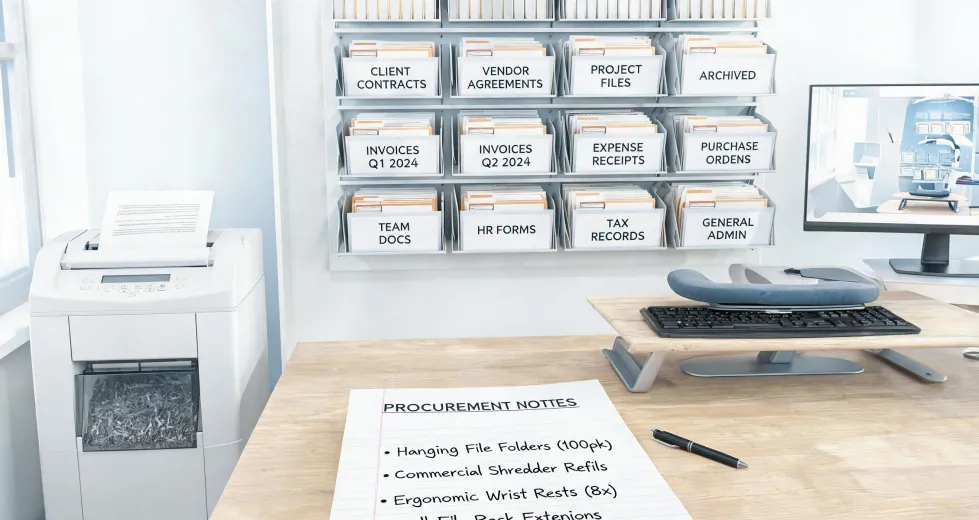
In March 2024, I pulled a document out of our shredding bin that was — to be honest — way too intact. The top third was still readable: a client's name, part of a contract clause. We'd been running two no-name shredders for years. They jammed every few days, so people just avoided them. And the "secure disposal" we thought we had? It wasn't secure at all.
I'm the office administrator for a 150-person company spread across three locations. I manage roughly $200,000 in annual procurement across a dozen vendors. My priorities are simple: keep the office running, keep finance happy, and don't make expensive mistakes. That shredder moment kicked off a four-month project to replace our equipment lineup — shredders, laminators, and eventually, the desk setups.
Here's how it went, and what I'd tell anyone about to do the same.
The Shredder Problem (and How the Fellowes 60CS Solved It)
Once I admitted we had a problem, I started researching what actually meets office security needs. The Fellowes 60CS paper shredder kept showing up in searches — and not just because it sells well. It's a cross-cut shredder with a P-4 security level. If you haven't fallen down that rabbit hole, P-4 is the DIN 66399 standard for destroying confidential documents into particles roughly 4 x 40 mm. For most offices, that's the level you actually need. Strip-cut is for junk mail, not client contracts.
The "60" in the name means it can take 60 sheets in a single pass. We usually shred 20–30 at a time, but the extra capacity means it never struggles with our normal loads. And reading through the Fellowes 60CS reviews, the thing people kept mentioning was jam prevention. Sounds boring — until you've spent 20 minutes untangling a shredded ribbon from a pair of rollers with a pair of scissors at 4:45 p.m. on a Friday.
I ordered three units, one for each office (this was around April 2024; we paid roughly $290 per unit, but check current pricing — the market moves).
Did I second-guess the order after hitting submit? Yes. What if the 60CS was overkill for a small office? What if employees still didn't use it because it meant walking to the supply room?
Nearly a year later, I can say it worked. The machine gets daily use. And we've had exactly one jam — someone fed it a binder clip. It stopped itself and recovered without damage, which is more than I can say for the old shredders (the ones we had to disassemble to clear).
The Laminator Question (and the Sublimation Printer Detour)
Around the same time, HR asked me to laminate a stack of policy documents and new-hire packets. We'd never owned a laminator. I did what any reasonable person does: read reviews until my eyes crossed.
The Fellowes Saturn 3i A4 laminator kept coming up, and the reviews were positive. But reviews only tell you so much. They can't tell you whether a machine will actually get used or sit in the supply closet gathering dust. Here's what convinced me:
The Saturn 3i is a thermal laminator (A4 and smaller, down to business-card size). It warms up in about 30 seconds. It accepts pouch thicknesses up to 125 microns, which is plenty for documents that need to survive regular handling. And the setup was genuinely simple — which mattered, because almost nobody in our office had ever operated a laminator.
One wrinkle during research: somebody asked whether we should get a sublimation printer instead, to print and laminate ID badges and such in one go. So let me save you the same search: what is a sublimation printer? It's a printer that uses heat to turn solid dye into a gas that bonds with polymer-coated materials — mugs, T-shirts, promotional products, certain plastic ID cards. It's great for merch and custom gifts. It is not a substitute for an office laminator, and it's not for standard paper documents. Unless you're producing custom ID badges at scale, you want a laminator, not a sublimation printer.
We bought the Saturn 3i (about $200 as of December 2024 via authorized dealers — verify current rates). But I learned the hard way that buying the machine is the easy part. You also have to buy the right pouches. Thermal, not cold. And — yes, I bought cold ones first. There was an exchange. It was mildly embarrassing.
The Standing Desk Converter Project (and the "What's Not Included?" Lesson)
The biggest project was the least glamorous: the sitting problem. After a quarterly safety review — and after several employees mentioned chronic back pain — I looked into sit-stand desks. Full motorized desks for twelve workstations? Not in the budget. Standing desk converters, though, are a different story. They sit on top of existing desks, lift the monitor and keyboard, and give you most of the ergonomic benefit for a fraction of the cost. They also install in minutes.
I got quotes from three vendors. The lowest one was about 15% below the middle option. I was ready to sign. Then I read the whole quote, line by line — a habit I picked up after a vendor once cost me $2,400 in rejected expenses for failing to provide proper invoicing. What wasn't included in the cheap quote? Delivery to a commercial address. Pallet handling. And the warranty was 12 months, not 36.
Once I added it all up, the "cheap" option was the same price as the mid-range option — with a worse warranty. I had almost made the mistake of trusting the first number I saw. Now, the question I ask every supplier is: "What's NOT included?" Before I ask the price. That one question would have saved me last year's invoice fiasco, and it would have saved this entire project from a dumb decision.
This is exactly the kind of thing that's obvious in hindsight but easy to miss when you're trying to hit a budget number. The vendor who lists every fee upfront — even if the total looks higher — usually ends up costing less.
The Palworld Breeding Calculator Moment
One afternoon, I found our summer intern huddled over his phone at lunch, running a breeding calculator for Palworld — a game where you combine creatures with different traits to produce better ones. The calculator tells you which pairings are worth trying so you don't waste time and resources on dead ends.
"It's like a spreadsheet," he said. "You plan the inputs, so nothing is wasted."
Yeah. That's exactly what buying office equipment is. But it took me three months and a few near-misses to start thinking that way. Instead of a calculated plan, I was playing a game of guessing.
(For the curious: the Palworld breeding calculator is a genuinely clever tool for that game. It has nothing to do with office supplies — it just happened to be the nudge that connected the dots for me.)
What I'd Do Differently
A year later, here's where things stand: the Fellowes 60CS shredders run in all three offices and the bins are actually being used. The Saturn 3i laminator gets weekly use — HR has run everything from policy pages to evacuation route maps through it. And the standing desk converters were worth it; people rotate between sitting and standing during the day, and the back-pain complaints have gone down noticeably.
If I had to do it over:
Start with "what's not included." The sticker price is the beginning, not the end. Add shipping, handling, warranty, setup, accessories. That's the real price.
Know the spec that actually matters. It's not the biggest number. It's the one that matches your use — security level for shredding, pouch size for lamination, load capacity for converters.
Buy the accessories at the same time. Laminator pouches, in the right type. Don't ask me how I know.
And don't replace what doesn't need replacing. Our old binding machine is still fine. Not everything needed upgrading; I almost got caught up in the momentum and bought one anyway.
One disclaimer: this worked for us because we're a mid-size company with predictable purchasing patterns. If you run a seasonal business or a large enterprise — or if you're handling classified material rather than confidential client documents — your requirements are going to be different. The principles about total cost, though, hold up anywhere.
Everything I've mentioned was accurate as of late 2024. Office equipment pricing changes, so verify current rates before you commit. And when you ask for a quote, ask the question first: what's not included? It'll save you more than any coupon code.

Leave a practical note